Silicon Carbide (SiC) porous ceramic supports are widely used in advanced membrane filtration systems due to their excellent thermal stability, high mechanical strength, and superior chemical resistance.
SiC-based ceramic materials are especially suitable for harsh environments such as high-temperature filtration, wastewater treatment, and chemical processing. However, conventional SiC ceramics require extremely high sintering temperatures (>2000°C), limiting large-scale industrial production.
To address this challenge, low-temperature liquid-phase sintering using glass additives has become an effective solution.
Low-Temperature Sintering Strategy for SiC Ceramics
In this study, a zirconium-containing glass frit derived from low-cost shale was introduced as a sintering aid to promote liquid-phase bonding and reduce sintering temperature significantly.
The glass frit is prepared by melting shale raw materials at 1500°C, forming a multi-oxide glass system containing:
- SiO₂, Al₂O₃, CaO (network structure)
- ZrO₂ (improves corrosion resistance)
- Fe₂O₃, MgO, Na₂O, K₂O (enhance sintering activity)
This approach enables SiC ceramics to be densified at 1100–1250°C, greatly reducing energy consumption.
Raw Materials and Fabrication Process
Raw Material System
- Silicon Carbide (SiC) powder (99.5% purity, D50 ≈ 15.1 μm)
- Zirconium-containing glass frit (low-temperature sintering additive)
- Graphite particles (D50 ≈ 19.4 μm, pore-forming agent)
- Carboxymethyl cellulose (CMC, binder)
Processing Steps
- Mixing SiC powder, glass frit, and graphite in designed ratios
- Ball milling with 0.5% CMC solution (30 minutes)
- Drying and granulation
- Uniaxial pressing at 30 MPa
- Sintering at 1100–1250°C for 3 hours
The final product is a porous SiC ceramic support with a stable interconnected pore network.
Microstructure and Performance Characterization
1. Porosity Control
Porosity is effectively controlled by adjusting glass frit and graphite content:
- Porosity: ~30%–40%
- Uniform and interconnected pore structure
- Stable pore size distribution
Graphite burns out during sintering, forming continuous open channels that enhance permeability.
2. Mechanical Strength
Under optimized conditions (20% glass frit, 15% graphite, sintered at 1180°C):
- Flexural strength: 67.1 MPa
- Balanced strength–porosity relationship
- Stable structural integrity
The glass phase improves particle bonding and enhances structural stability.
3. Phase Composition Analysis
X-ray diffraction results indicate:
- Main phase: SiC
- Minor glassy phase present
- No destructive secondary phases observed
This confirms that liquid-phase sintering dominates the densification mechanism.
4. Microstructure (SEM Observation)
Microstructural analysis reveals:
- Uniform distribution of SiC particles
- Glass phase bonding between particles
- Well-developed interconnected pore channels
- Average pore size: 1.37 μm
This structure is ideal for membrane filtration applications.
5. Permeability and Water Flux
The optimized porous SiC support exhibits:
- Average pore size: 1.37 μm
- Pure water flux: 8075 L/(m²·h·bar)
This demonstrates excellent permeability performance for microfiltration systems.
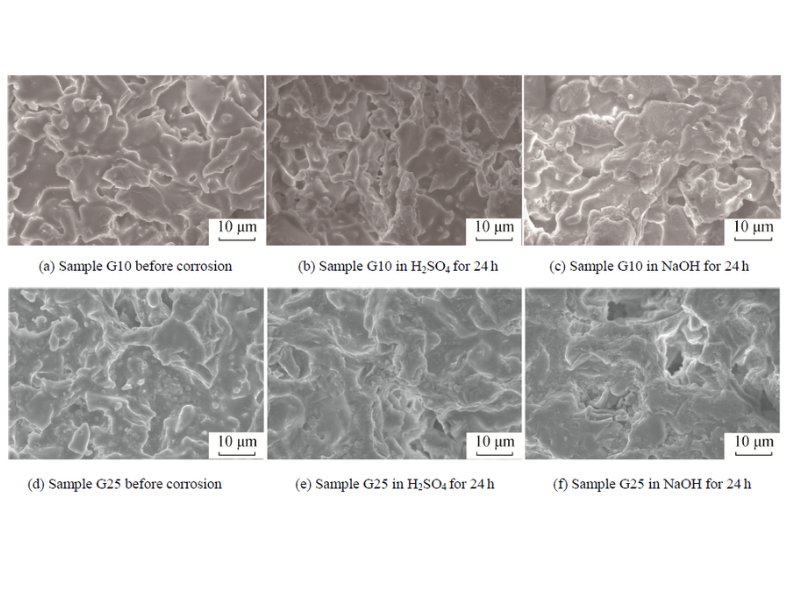
6. Acid and Alkali Corrosion Resistance
Chemical stability was evaluated under extreme conditions:
- Acidic environment: pH = 0 (H₂SO₄, 80°C)
- Alkaline environment: pH = 14 (NaOH, 80°C)
- Immersion time: 24 hours
Results:
- Acid-treated flexural strength retention: 47.4 MPa (29.4% loss)
- Alkali-treated flexural strength retention: 46.7 MPa (30.4% loss)
The sample with 20% glass frit shows the best overall chemical stability.
Key Advantages of Porous SiC Ceramic Supports
- ✔ Low-temperature sintering (1100–1250°C)
- ✔ High porosity (~36%)
- ✔ High flexural strength (67.1 MPa)
- ✔ Ultra-high water flux (8075 L/m²·h·bar)
- ✔ Excellent acid and alkali resistance
- ✔ Low-cost raw materials (shale-derived glass frit)
Industrial Applications
Porous SiC ceramic supports are widely used in:
- Industrial wastewater treatment membranes
- High-temperature gas filtration systems
- Chemical separation and purification units
- Catalyst support structures
- Precision microfiltration membranes
Conclusion
This study presents a cost-effective approach for preparing porous SiC ceramic supports using a shale-derived zirconium glass frit as a sintering aid.
Key outcomes include:
- Significant reduction in sintering temperature
- Improved pore structure controllability
- Enhanced mechanical and permeability performance
- Strong resistance to acidic and alkaline environments
This technology provides a promising pathway for the large-scale industrial application of SiC-based ceramic membrane supports in harsh operating conditions.