Dans les équipements modernes de fabrication de semi-conducteurs, les céramiques avancées ne sont plus des composants optionnels, mais des matériaux habilitants critiques qui déterminent la précision, la stabilité et la fiabilité du processus.
Des chambres de gravure au plasma aux systèmes de manipulation des plaquettes, différents matériaux céramiques sont sélectionnés en fonction des exigences de performances thermiques, électriques et mécaniques.
Cet article présente les céramiques de qualité semi-conducteur les plus utilisées et fournit une comparaison technique claire pour la prise de décision en matière d'ingénierie et d'approvisionnement.

1. Pourquoi les céramiques sont-elles essentielles dans les équipements semi-conducteurs ?
Les environnements de production de semi-conducteurs impliquent :
- Températures extrêmes (jusqu'à 1000°C+)
- Environnements de corrosion par plasma
- Systèmes d'ultravide
- Conditions électriques à haute tension
- Exigences de précision au niveau du nanomètre
Les métaux traditionnels présentent des défauts d'isolation, de résistance à la corrosion ou de stabilité thermique. Les céramiques avancées résolvent ces problèmes.
2. Matériaux céramiques les plus utilisés
2.1 Alumine (Al₂O₃) - Le matériau de référence de l'industrie
La céramique d'alumine est le matériau le plus largement utilisé, représentant environ 45% des applications céramiques semi-conductrices.
Applications clés :
- Revêtements de chambres de gravure
- Anneaux de support de plaquettes
- Plaques de distribution de gaz
- Mandrins à vide
- Composants de polissage CMP
Principaux avantages :
- Isolation électrique stable
- Bonne résistance thermique
- Production de masse rentable
- Technologie de traitement mature
2.2 Yttria (Y₂O₃) - Céramique résistante au plasma
L'yttrium est largement utilisé dans les environnements à forte intensité de plasma en raison de son excellente résistance à la corrosion.
Applications clés :
- Revêtements des chambres de gravure
- Hublots optiques
- Composants orientés vers le plasma
Principaux avantages :
- Résistance supérieure à la corrosion par plasma par rapport à l'Al₂O₃
- Point de fusion élevé (~2430°C)
- Souvent utilisé comme couche de revêtement pour réduire les coûts
2.3 Carbure de silicium (SiC) - Céramique structurelle de haute précision
Le carbure de silicium offre une rigidité et une stabilité thermique exceptionnelles, ce qui le rend idéal pour les équipements de précision.
Applications clés :
- Etages des machines de lithographie
- Bagues de mise au point
- Rails de guidage de précision
- Mandrins et miroirs pour plaquettes de silicium
Principaux avantages :
- Très grande rigidité
- Faible dilatation thermique
- Excellente conductivité thermique
- Surface polissable par miroitement
2.4 Nitrure de silicium (Si₃N₄) - Céramique technique à haute fiabilité
Le nitrure de silicium est connu pour son excellente résistance mécanique et aux chocs thermiques.
Applications clés :
- Paliers
- Systèmes de guidage linéaire
- Bras mécaniques
- Pièces structurelles à forte charge
Principaux avantages :
- Ténacité élevée à la rupture
- Excellente résistance aux chocs thermiques
- Performances stables à haute température (jusqu'à 1200°C+)
2.5 Nitrure d'aluminium (AlN) - La céramique thermique de la prochaine génération
L'AlN est de plus en plus utilisé dans les systèmes semi-conducteurs de haute puissance en raison de sa conductivité thermique.
Applications clés :
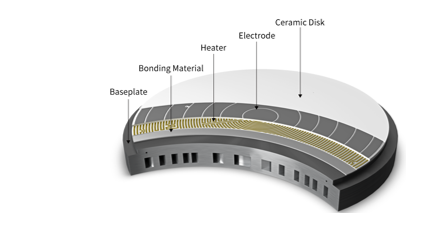
- Mandrins électrostatiques (ESC)
- Substrats électroniques de haute puissance
- Modules RF et de puissance
Principaux avantages :
- Conductivité thermique élevée (bien supérieure à celle de l'Al₂O₃)
- Excellente isolation électrique
- Réduction du décalage des contraintes thermiques
3. Tableau de comparaison technique
| Matériau | Conductivité thermique (W/m-K) | Isolation électrique | Résistance aux chocs thermiques | Résistance au plasma | Principaux cas d'utilisation |
|---|---|---|---|---|---|
| Al₂O₃ (Alumine) | 20-30 | Excellent | Moyen | Moyen | Pièces structurelles générales |
| Y₂O₃ (Yttria) | 10-15 | Excellent | Bon | Excellent | Revêtements de chambres à plasma |
| SiC (carbure de silicium) | 120-200 | Bon | Excellent | Bon | Pièces structurelles de précision |
| Si₃N₄ (nitrure de silicium) | 20-90 | Bon | Excellent | Bon | Roulements et systèmes mécaniques |
| AlN (nitrure d'aluminium) | 140-180 | Excellent | Bon | Moyen | Gestion thermique (ESC) |
4. Carte des applications dans les équipements semi-conducteurs
Équipement de traitement frontal
- Chambres de gravure → Al₂O₃ / Y₂O₃
- Systèmes de dépôt → Al₂O₃ / SiC
- Environnements plasma → revêtement Y₂O₃.
Systèmes de manutention des plaquettes
- Bras de robot → Si₃N₄ / SiC
- Mandrins à vide → Al₂O₃ / AlN
- Rails de guidage → SiC / Si₃N₄
Systèmes de gestion thermique
- ESC (Electrostatic Chuck) → AlN / Al₂O₃
- Diffuseurs de chaleur → AlN
- Plaques de refroidissement de précision → Al₂O₃ / SiC
5. Guide de sélection des matériaux (vue technique)
- Applications sensibles aux coûts → Al₂O₃
- Environnement de corrosion par plasma → Y₂O₃
- Structure de haute précision → SiC
- Charge mécanique et durabilité → Si₃N₄
- Dissipation thermique élevée → AlN
6. Tendance future : systèmes céramiques hybrides
Les équipements semi-conducteurs de la prochaine génération s'orientent vers.. :
- Systèmes céramiques revêtus (Al₂O₃ + Y₂O₃)
- Plateformes structurelles SiC
- Intégration de la gestion thermique de l'AlN
- Assemblages céramiques hybrides multi-matériaux
Cette tendance améliore considérablement la durée de vie des équipements et la stabilité des processus.
Conclusion
Les céramiques avancées sont devenues l'épine dorsale des équipements de fabrication de semi-conducteurs. Chaque matériau joue un rôle spécialisé, du soutien structurel à la résistance au plasma et à la gestion thermique.
Le choix du bon matériau céramique a un impact direct :
- Durée de vie de l'équipement
- Stabilité du processus
- Taux de rendement
- Coût de la maintenance
Demande Composants céramiques sur mesure
Nous fournissons :
- Pièces en céramique d'alumine (Al₂O₃)
- Composants de précision en carbure de silicium (SiC)
- Pièces de structure en nitrure de silicium (Si₃N₄)
- Substrats thermiques en nitrure d'aluminium (AlN)
- Solutions de revêtement en yttrium (Y₂O₃)
👉 Dimensions personnalisées, usinage, polissage, revêtement et assistance technique disponibles.