In semiconductor manufacturing, wafer positioning and fixation are fundamental requirements for achieving process precision and yield stability. During etching, deposition, lithography, inspection, and plasma processing, silicon wafers must remain securely held while maintaining minimal contamination and excellent thermal uniformity.
As device structures continue shrinking and wafer sizes continue increasing, traditional holding methods face growing challenges. Two of the most widely used wafer fixation technologies today are Electrostatic Chucks (ESCs) and Vacuum Chucks.
Although both systems serve the same general purpose—holding wafers in place—their working principles, operating environments, and performance characteristics differ significantly.
Understanding these differences is essential for equipment designers, process engineers, and semiconductor manufacturers.
Why Wafer Holding Technology Matters
Modern semiconductor processing requires:
- Nanometer-scale positioning precision
- Excellent thermal uniformity
- Low particle generation
- Stable wafer flatness
- Vacuum compatibility
- Resistance to plasma environments
Even slight wafer movement may cause:
- Overlay errors
- Process non-uniformity
- Defect generation
- Yield reduction
As a result, wafer fixation systems have evolved into highly engineered components rather than simple support structures.
What Is a Vacuum Chuck?
A vacuum chuck uses pressure differentials to secure wafers.
Vacuum channels are integrated into the chuck surface. When vacuum is applied, air beneath the wafer is removed, generating suction force.
Basic operating principle:
- Wafer placed on chuck surface
- Air evacuated through internal channels
- Atmospheric pressure creates holding force
- Wafer remains fixed during processing
Vacuum chucks are widely used because of their simple structure and mature technology.
Typical applications include:
- Wafer inspection
- Grinding
- Polishing
- Dicing
- Metrology
- Low-temperature handling systems
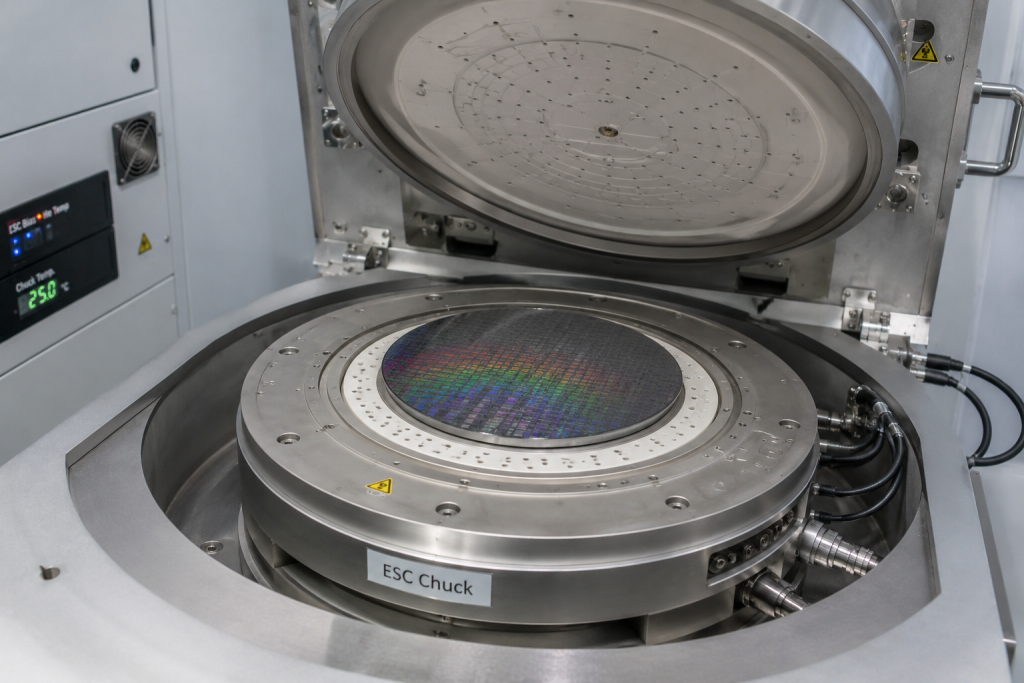
What Is an Electrostatic Chuck?
Electrostatic chucks use electrostatic attraction instead of pressure differences.
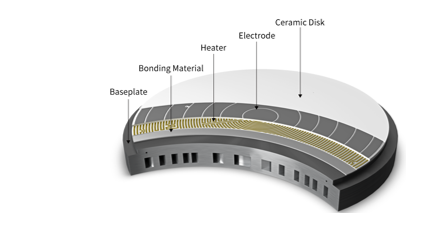
When voltage is applied across embedded electrodes, an electrostatic field develops and attracts the wafer to the chuck surface.
Basic process:
- Wafer contacts chuck surface
- High voltage applied internally
- Electrostatic force generated
- Wafer held firmly in position
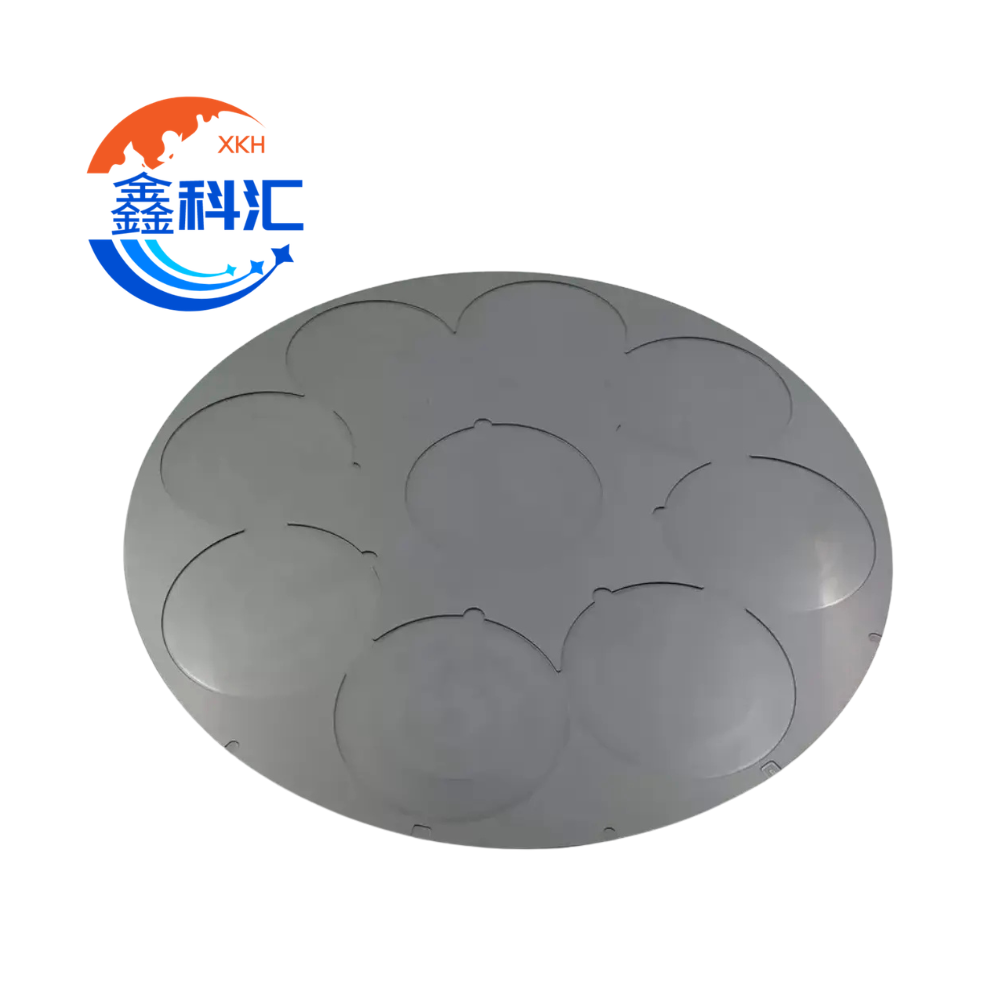
ESC systems often use advanced ceramic materials including:
- Alumina (Al₂O₃)
- Aluminum Nitride (AlN)
- Silicon Carbide (SiC)
These materials provide:
- Electrical insulation
- Plasma resistance
- Thermal stability
- Controlled dielectric properties
ESC technology is commonly found in:
- Plasma etching
- PVD systems
- CVD equipment
- Ion implantation
- Semiconductor process chambers
Fundamental Difference in Holding Mechanisms
| Property | Vacuum Chuck | Electrostatic Chuck |
|---|---|---|
| Holding Method | Pressure differential | Electrostatic attraction |
| Contact Principle | Vacuum suction | Electric field |
| Operating Requirement | Atmospheric pressure difference | High voltage |
| Vacuum Environment Compatibility | Limited | Excellent |
This distinction strongly affects process suitability.
Performance Under Vacuum Conditions
Semiconductor plasma processes frequently operate under high vacuum.
Vacuum chuck performance depends on pressure differences.
As chamber pressure decreases:
- Available suction force decreases
- Holding capability becomes limited
In extreme vacuum environments, traditional vacuum chucks may lose effectiveness.
Electrostatic chucks maintain stable holding force even under very low pressure.
This makes ESCs highly suitable for:
- Dry etching
- Plasma deposition
- Advanced semiconductor processing
Thermal Performance Comparison
Thermal management has become increasingly important in advanced semiconductor manufacturing.
Wafer temperature directly affects:
- Etch rates
- Film deposition
- Process uniformity
- Critical dimensions
Comparison:
| Property | Vacuum Chuck | Electrostatic Chuck |
|---|---|---|
| Thermal Contact | Moderate | Excellent |
| Temperature Uniformity | Moderate | High |
| Heat Transfer Efficiency | Limited | Better |
| Process Stability | Moderate | High |
Many ESC designs incorporate backside gas cooling systems that improve heat transfer.
This becomes essential during plasma-intensive processing.
Particle Generation and Contamination
Contamination control remains one of the most critical concerns in semiconductor manufacturing.
Mechanical movement and unstable wafer contact can generate particles.
Vacuum systems may experience:
- Surface leakage
- Micro-vibration
- Local contact variation
Electrostatic systems generally provide:
- More uniform contact
- Reduced movement
- Better positional stability
Lower particle generation often translates into:
- Higher yield
- Better repeatability
- Reduced defect rates
Material Requirements for ESC Systems
Unlike vacuum chucks, electrostatic chucks rely heavily on material engineering.
ESC ceramics must simultaneously provide:
- Controlled electrical resistivity
- Thermal conductivity
- Plasma resistance
- Mechanical strength
- Dimensional stability
Common ceramic materials include:
| Material | Main Advantages |
|---|---|
| Alumina | Cost-effective and stable |
| Aluminum Nitride | High thermal conductivity |
| Silicon Carbide | Excellent plasma resistance |
Material selection often depends on process conditions.
Advantages and Limitations
Vacuum Chuck Advantages
- Simpler structure
- Lower cost
- Mature technology
- Easier maintenance
Limitations:
- Reduced performance under vacuum
- Lower thermal efficiency
- Limited plasma compatibility
Electrostatic Chuck Advantages
- Strong holding force
- Excellent vacuum compatibility
- Better thermal performance
- Stable wafer positioning
- Lower contamination risk
Limitations:
- Higher cost
- Complex manufacturing
- Requires high-voltage systems
- More demanding material requirements
Typical Application Comparison
Vacuum Chuck Applications
- Wafer polishing
- Inspection equipment
- Grinding processes
- Packaging systems
- General wafer handling
Electrostatic Chuck Applications
- Plasma etching
- PVD deposition
- CVD chambers
- Ion implantation
- Advanced semiconductor processing
In practice, these technologies are often complementary rather than competitive.
Future Trends
As semiconductor manufacturing moves toward:
- Larger wafers
- Smaller process nodes
- Higher plasma densities
- More complex device architectures
Electrostatic chuck adoption continues increasing.
Advanced ceramics and improved thermal designs are expected to further enhance ESC performance.
However, vacuum chucks will likely remain valuable for lower-cost and less demanding applications.
Final Thoughts
Electrostatic chucks and vacuum chucks achieve the same fundamental goal—holding wafers securely during processing—but they use fundamentally different physical principles.
Vacuum chucks remain practical and economical for many traditional applications. Electrostatic chucks provide superior performance in advanced semiconductor environments involving vacuum, plasma, and strict thermal requirements.
As semiconductor manufacturing technology advances, choosing the appropriate wafer holding method becomes increasingly important for process performance and yield optimization.
Understanding these technologies allows engineers to make better material and equipment decisions.
FAQ
Why are electrostatic chucks commonly used in plasma etching systems?
Because they provide stable holding force under high-vacuum environments and offer better thermal control during plasma exposure.
Can vacuum chucks operate in semiconductor vacuum chambers?
They can operate in some environments, but holding performance decreases significantly under very low-pressure conditions.
What ceramic materials are commonly used in electrostatic chucks?
What ceramic materials are commonly used in electrostatic chucks?