Advanced ceramics have become essential materials in industries requiring exceptional wear resistance, high strength, thermal stability, and chemical durability. Among the most widely used engineering ceramics, zirconia (ZrO₂) and alumina (Al₂O₃) stand out due to their broad industrial applications and excellent performance characteristics.
However, engineers and purchasing teams often face a key question:
Which ceramic material performs better—zirconia or alumina?
The answer depends on operating conditions, mechanical requirements, cost targets, and application environments. This article provides a detailed comparison of zirconia and alumina across material properties, performance, applications, and selection guidelines.
Understanding Zirconia and Alumina Ceramics
What Is Zirconia Ceramic?
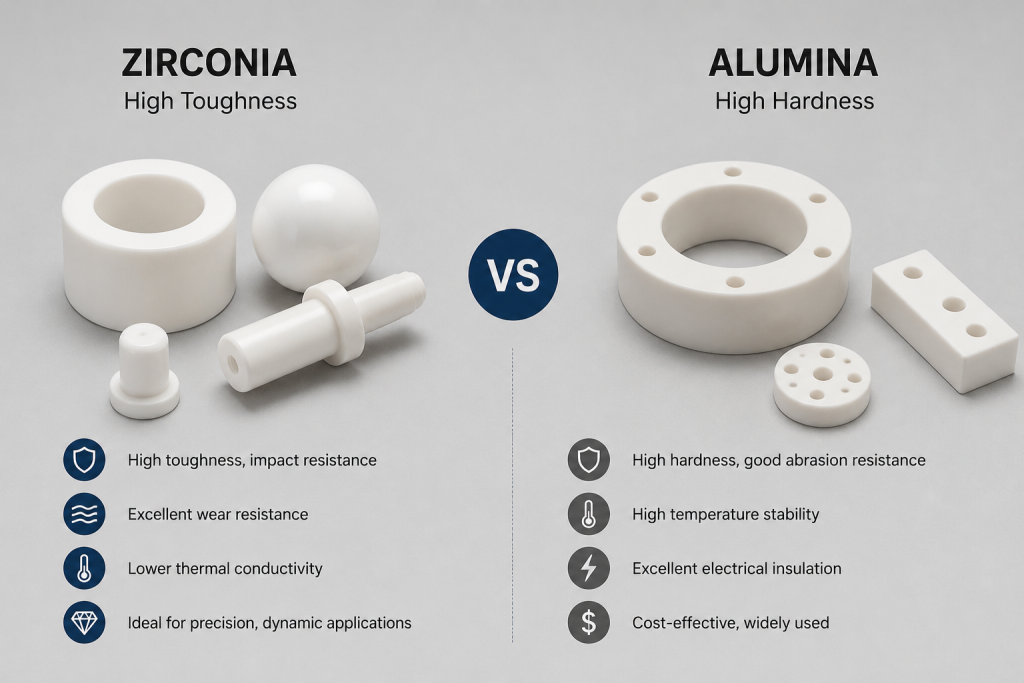
Zirconia, or zirconium dioxide (ZrO₂), is an advanced ceramic known for its exceptional toughness and mechanical strength. Unlike many brittle ceramic materials, zirconia exhibits a unique transformation toughening mechanism that improves crack resistance.
Key characteristics:
- Extremely high fracture toughness
- 優れた耐摩耗性
- High bending strength
- Low thermal conductivity
- Strong resistance to crack propagation
Because of its toughness, zirconia is often called the “ceramic steel.”
Common zirconia types include:
- Y-TZP (Yttria Stabilized Zirconia)
- MgO-stabilized zirconia
- Partially stabilized zirconia
What Is Alumina Ceramic?
Alumina (Al₂O₃) is one of the most widely used technical ceramics globally due to its cost-performance balance and excellent electrical insulation.
Typical features:
- 高い硬度
- 優れた耐食性
- High temperature stability
- 電気絶縁
- High purity availability
- Relatively low production cost
Industrial grades commonly include:
- 95% アルミナ
- 99%アルミナ
- 99.5%+ High-purity alumina
Property Comparison: Zirconia vs Alumina
The biggest differences emerge when comparing core performance indicators.
| プロパティ | ジルコニア (ZrO₂) | アルミナ(Al₂O₃) |
|---|---|---|
| 密度 | ~6.0 g/cm³ | ~3.9 g/cm³ |
| 硬度 | 高い | 非常に高い |
| 曲げ強度 | 非常に高い | Moderate |
| Fracture Toughness | 素晴らしい | Moderate |
| 熱伝導率 | 低い | Moderate |
| Maximum Service Temperature | ~1000–1200°C | ~1600°C+ |
| 耐摩耗性 | 素晴らしい | Very Good |
| 耐食性 | 素晴らしい | 素晴らしい |
| 電気絶縁 | 素晴らしい | 素晴らしい |
| Cost | Higher | Lower |
From this comparison, neither material dominates every category.
Each has unique strengths.
Mechanical Performance Comparison
Strength and Toughness
One of zirconia’s biggest advantages is toughness.
Typical fracture toughness values:
Zirconia:
6–10 MPa·m½
Alumina:
3–4 MPa·m½
This means zirconia can better resist:
- Impact loads
- Mechanical shocks
- Crack growth
- Cyclic stress
Applications involving moving parts often favor zirconia.
Examples:
- Bearings
- Valve components
- Ceramic shafts
- Wear assemblies
硬度
Alumina generally possesses higher hardness values.
Typical Vickers hardness:
Alumina:
1500–2000 HV
Zirconia:
1200–1400 HV
Higher hardness provides:
- Better abrasion resistance
- Scratch resistance
- Surface durability
For sliding wear applications without impact loading, alumina can perform extremely well.
Thermal Performance Comparison
Temperature capability strongly affects material selection.
Alumina Advantages
Alumina maintains excellent properties at elevated temperatures.
Operating temperatures may exceed:
1600°C
Applications:
- Furnace components
- High-temperature insulators
- Semiconductor processing equipment
Zirconia Advantages
Zirconia offers lower thermal conductivity.
Benefits include:
- Heat insulation
- Thermal barrier applications
- Reduced heat transfer
Applications:
- Thermal shields
- Heating system components
- Specialized industrial systems
Wear Resistance Comparison
Both ceramics demonstrate excellent wear resistance.
However, wear behavior differs depending on operating conditions.
Zirconia performs better in:
- High-load wear
- Dynamic contact
- Impact wear
- Precision moving assemblies
Alumina performs better in:
- Abrasive environments
- Static wear conditions
- Low-cost wear components
Chemical Resistance Comparison
Both materials resist:
- Acids
- Alkalis
- Solvents
- Corrosive chemicals
Alumina particularly performs well under:
- Oxidizing environments
- High-temperature chemical exposure
Zirconia often performs better under:
- Biological environments
- Specialized wear fluids
Semiconductor Applications
Both materials play important roles in semiconductor equipment.
Alumina semiconductor components:
- Insulators
- Wafer guides
- Chamber parts
- ノズル
- Structural supports
利点がある:
- 高純度
- Cost efficiency
- Excellent insulation
Zirconia semiconductor components:
- Precision positioning components
- Wear-resistant assemblies
- Bearings
- Robotic handling components
利点がある:
- Superior toughness
- Better resistance to mechanical failure
Machining and Manufacturing Considerations
Manufacturing cost differs substantially.
Alumina advantages:
- Easier to process
- Mature manufacturing ecosystem
- Lower raw material cost
- Broad supplier availability
Zirconia challenges:
- Higher material cost
- More complex processing
- Increased machining difficulty
- Higher precision requirements
Complex zirconia parts often require:
- Precision grinding
- CNC machining
- Diamond tooling
These increase overall cost.
Cost Comparison
Approximate relative cost:
Alumina:
Baseline
Zirconia:
1.5–4× higher depending on purity and complexity
Therefore, replacing alumina with zirconia does not always provide economic benefits.
Selection should focus on performance requirements.
Which Material Performs Better?
The answer depends entirely on application conditions.
Choose Zirconia if you need:
✓ High mechanical strength
✓ Superior fracture toughness
✓ Impact resistance
✓ Precision moving components
✓ Long service life under mechanical stress
Choose Alumina if you need:
✓ High temperature resistance
✓ Excellent electrical insulation
✓ Lower material cost
✓ Abrasion resistance
✓ Large-scale industrial use
結論
Zirconia and alumina are both high-performance engineering ceramics, but they serve different purposes.
Zirconia excels in toughness, strength, and dynamic applications, making it ideal for demanding mechanical systems and precision wear components.
Alumina remains the industry’s workhorse due to its excellent balance of thermal performance, electrical insulation, wear resistance, and cost efficiency.
Instead of asking which ceramic is universally better, engineers should evaluate:
- Operating temperature
- Mechanical loading
- Wear conditions
- Precision requirements
- Chemical exposure
- Budget considerations
Proper material selection ultimately determines system reliability and performance.