Modern semiconductor manufacturing requires unprecedented levels of precision, cleanliness, thermal stability, and reliability. As chip architectures continue to evolve toward smaller nodes, higher power density, and advanced packaging technologies, conventional metallic materials increasingly face limitations in process environments involving plasma exposure, ultra-high vacuum, aggressive chemicals, and extreme temperatures.
Structural ceramics have therefore become indispensable materials in semiconductor equipment. Their unique combination of mechanical strength, wear resistance, thermal stability, corrosion resistance, and electrical properties makes them essential for wafer processing, handling, deposition, etching, and inspection systems.
This article provides an in-depth analysis of structural ceramics used in semiconductor manufacturing, including material types, critical properties, equipment applications, selection criteria, and future industry trends.
What Are Structural Ceramics?
Structural ceramics are engineered ceramic materials primarily designed for mechanical and functional performance under demanding operating conditions. Unlike decorative or traditional ceramics, advanced structural ceramics possess highly controlled microstructures and exceptional material properties.
In semiconductor environments, structural ceramics are expected to provide:
- High dimensional accuracy
- Excellent thermal stability
- Resistance to plasma erosion
- Low particle generation
- Chemical inertness
- High purity
- Electrical insulation or conductivity depending on application
- Long-term reliability under vacuum conditions
As semiconductor processes become increasingly sensitive to contamination, even microscopic material degradation can affect wafer yield.
Why Structural Ceramics Matter in Semiconductor Manufacturing
Semiconductor equipment operates under conditions far more severe than conventional industrial systems.
Typical environments include:
Extreme temperature cycles
- Rapid heating and cooling
- Temperatures from cryogenic conditions to over 1600°C
- Thermal shock stress
Aggressive chemical exposure
- Acids
- Alkalis
- Reactive gases
- Cleaning chemistries
Plasma processing
Etching and deposition chambers use energetic plasmas capable of damaging conventional materials.
Ultra-clean environments
Particles measured in nanometers may significantly impact device performance.
Vacuum operation
Many semiconductor systems operate in:
- High vacuum
- Ultra-high vacuum
- Controlled atmosphere environments
Structural ceramics outperform metals in many of these situations because they resist corrosion, deformation, oxidation, and contamination.
Major Structural Ceramic Materials Used in Semiconductor Equipment
Different ceramic materials are selected according to process requirements.
Silicon Carbide (SiC)
Silicon carbide is among the most important semiconductor structural ceramics.
Key properties:
- Extremely high hardness
- High thermal conductivity
- Excellent wear resistance
- Plasma resistance
- High-temperature stability
- Low thermal expansion
Applications:
- Wafer carriers
- Vacuum chucks
- susceptors
- process trays
- robot arms
- wafer support structures
Reaction-bonded SiC and recrystallized SiC are commonly used in thermal processing systems.
Advantages:
- Excellent dimensional stability
- Reduced particle contamination
- Long service life
Alumina (Al2O3)
Alumina remains one of the most widely used ceramic materials due to cost-performance balance.
Typical properties:
- Electrical insulation
- High hardness
- Good corrosion resistance
- Low cost
- High purity availability
Applications:
- Ceramic insulators
- nozzles
- guide components
- chamber parts
- positioning components
Purity levels often exceed:
99.5%
Ultra-high purity grades may exceed:
99.9%
Higher purity reduces contamination risk.
Zirconia (ZrO2)
Zirconia provides exceptional fracture toughness.
Characteristics:
- High bending strength
- Wear resistance
- Low thermal conductivity
- Excellent crack resistance
Applications:
- precision wear components
- bearings
- valve parts
- positioning systems
Transformation toughening mechanisms provide improved resistance to mechanical failure.
Aluminum Nitride (AlN)
Aluminum nitride is increasingly important because of its thermal conductivity.
Properties:
- High thermal conductivity
- Electrical insulation
- thermal expansion close to silicon
Applications:
- electrostatic chuck substrates
- thermal management components
- semiconductor heaters
AlN combines heat transfer capability with electrical isolation.
Quartz and Fused Silica
Although technically different from engineering structural ceramics, these materials remain essential.
Applications include:
- process tubes
- wafer boats
- diffusion equipment
- optical components
Advantages:
- high purity
- low thermal expansion
- transparency
Key Applications of Structural Ceramics in Semiconductor Equipment
Structural ceramics appear throughout semiconductor production lines.
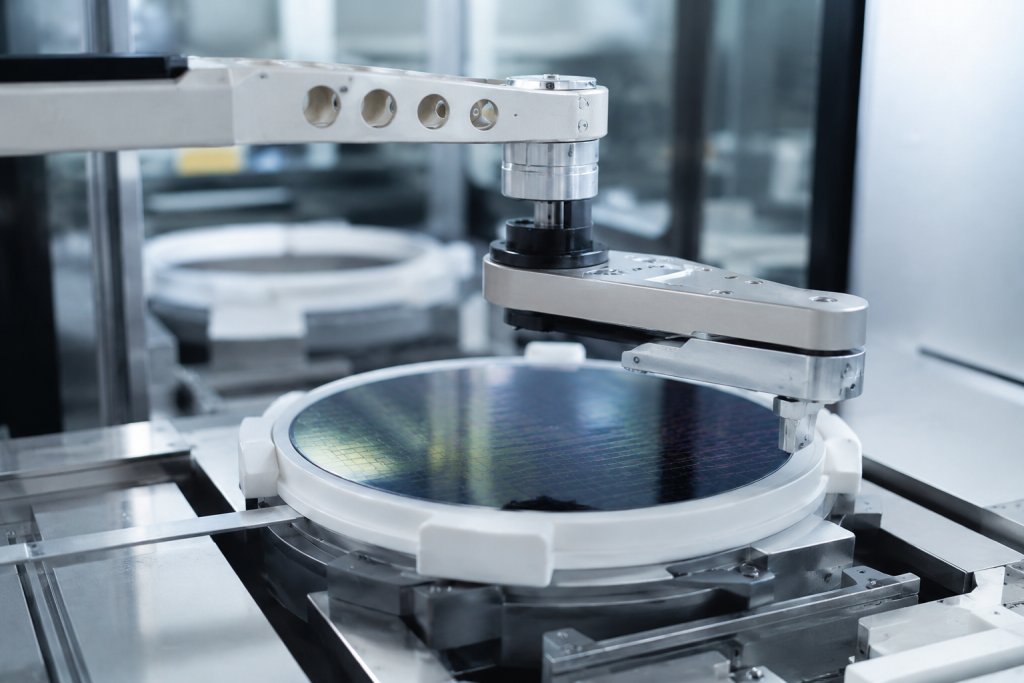
Wafer Handling Systems
Wafer transport systems require:
- dimensional precision
- low particle generation
- wear resistance
Components:
- robotic end effectors
- vacuum arms
- guide rails
- support pins
Ceramics reduce abrasion and contamination.
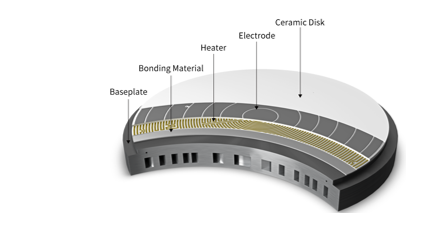
Electrostatic Chucks
Electrostatic chucks secure wafers during processing.
Requirements:
- controlled electrical properties
- thermal uniformity
- plasma resistance
Common materials:
- AlN
- SiC
- alumina composites
Performance directly influences process uniformity.
Etching Equipment Components
Plasma etching chambers expose materials to energetic ions and reactive species.
Ceramic components include:
- focus rings
- gas distribution plates
- chamber liners
- edge rings
SiC and high-purity alumina dominate these applications.
CVD and Epitaxy Systems
Chemical vapor deposition processes involve elevated temperatures.
Ceramic applications:
- susceptors
- process trays
- wafer carriers
- thermal shields
Thermal stability becomes critical.
CMP Systems
Chemical mechanical polishing requires components resistant to both chemistry and abrasion.
Applications:
- wear rings
- precision bearings
- fluid handling parts
Comparison of Major Semiconductor Structural Ceramics
| Property | SiC | Alumina | Zirconia | AlN |
|---|---|---|---|---|
| Hardness | Very High | High | Medium | Medium |
| Thermal Conductivity | Excellent | Low | Low | Excellent |
| Electrical Insulation | Moderate | Excellent | Excellent | Excellent |
| Plasma Resistance | Excellent | Good | Moderate | Good |
| Fracture Toughness | Moderate | Moderate | Excellent | Moderate |
| Wear Resistance | Excellent | Good | Excellent | Moderate |
| Thermal Shock Resistance | Excellent | Moderate | Good | Good |
No single ceramic material solves every engineering challenge.
Selection depends on:
- process environment
- temperature
- plasma intensity
- mechanical load
- contamination requirements
- equipment architecture
Manufacturing Challenges for Semiconductor Structural Ceramics
Producing semiconductor-grade ceramics is significantly more complex than conventional industrial ceramics.
Challenges include:
Ultra-high purity requirements
Trace contamination can affect chip yield.
Impurities often must remain below ppm levels.
Precision machining
Tolerances frequently reach:
±0.005 mm
or tighter.
Processes include:
- CNC machining
- precision grinding
- lapping
- polishing
Surface quality control
Surface defects generate particles.
Critical parameters include:
- surface roughness
- flatness
- edge quality
Some applications require sub-micron flatness.
Complex geometries
Modern semiconductor equipment increasingly uses customized components:
- vacuum channels
- microstructures
- multi-functional assemblies
Advanced ceramic machining technologies are essential.
Emerging Trends in Semiconductor Structural Ceramics
The industry continues evolving rapidly.
Several trends are reshaping ceramic development:
Larger wafer formats
As equipment transitions toward larger wafers and advanced packaging, larger ceramic structures become necessary.
Higher plasma density
Future etching technologies require materials with improved plasma durability.
Hybrid ceramic materials
Composite systems combining:
- SiC
- AlN
- ceramic coatings
are increasingly used.
Additive manufacturing
3D-printed ceramics may enable:
- lightweight structures
- complex channels
- reduced assembly requirements
Advanced surface engineering
Surface treatments can improve:
- contamination resistance
- wear behavior
- process life
Conclusion
Structural ceramics have become fundamental enabling materials in semiconductor manufacturing equipment. Their exceptional combination of thermal stability, wear resistance, corrosion resistance, purity, and mechanical performance allows them to operate in environments beyond the capabilities of conventional materials.
As semiconductor technologies continue advancing toward smaller process nodes and increasingly demanding manufacturing conditions, structural ceramics will play an even greater role in improving process stability, yield, and equipment reliability.
Future developments in ceramic materials, manufacturing precision, and functional integration will likely determine the next generation of semiconductor equipment innovation.