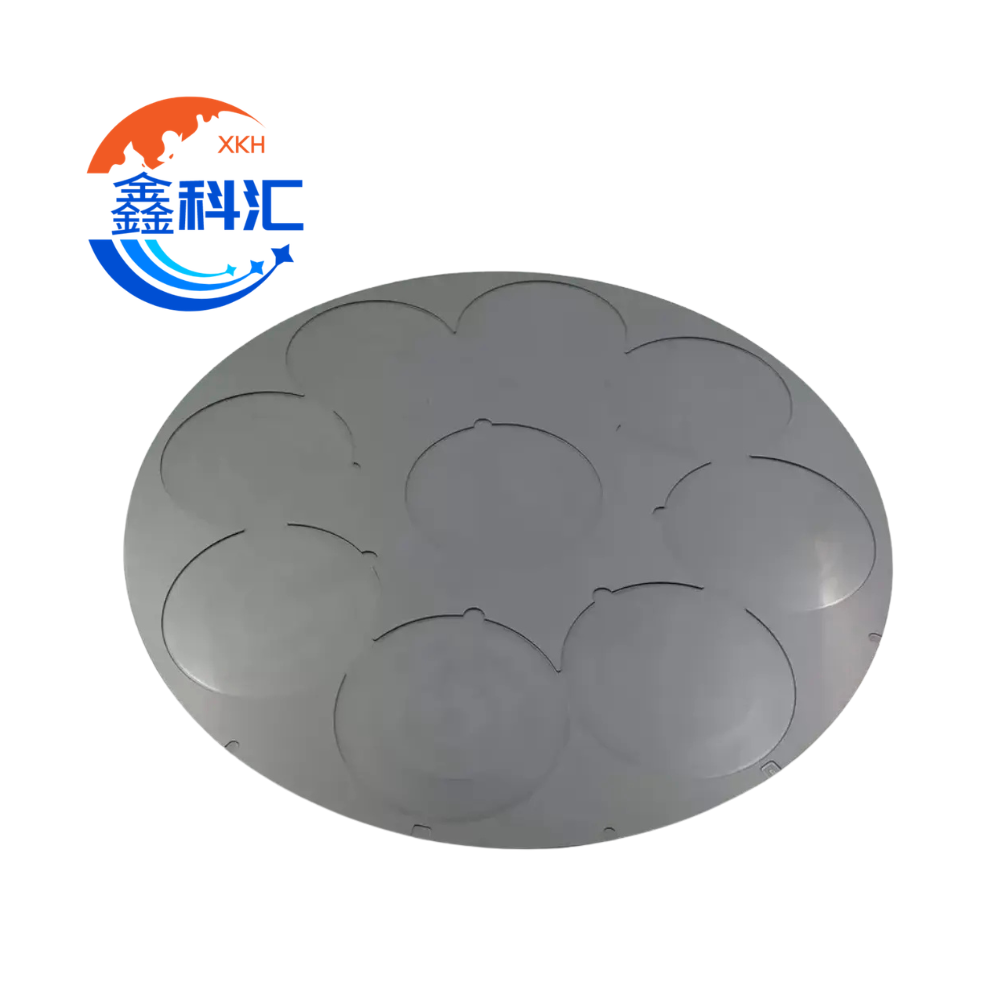
Modern semiconductor manufacturing relies heavily on advanced equipment such as etching systems, lithography machines, ion implantation tools, and deposition equipment. Inside these systems, numerous ceramic components play critical roles in ensuring process stability, precision, and reliability.
Thanks to their exceptional high-temperature resistance, corrosion resistance, mechanical strength, dimensional stability, and electrical properties, advanced ceramic components are widely used throughout semiconductor fabrication processes. Many of these components come into direct contact with wafers and are responsible for precise temperature control, plasma resistance, vacuum handling, and contamination reduction.
Common semiconductor ceramic materials include:
- Глинозем (Al₂O₃)
- Карбид кремния (SiC)
- Нитрид алюминия (AlN)
- Нитрид кремния (Si₃N₄)
- Yttria (Y₂O₃)
Typical semiconductor ceramic components include:
- Ceramic robot arms (end effectors)
- Ceramic nozzles
- Ceramic windows
- Chamber liners and shields
- Porous ceramic vacuum chucks
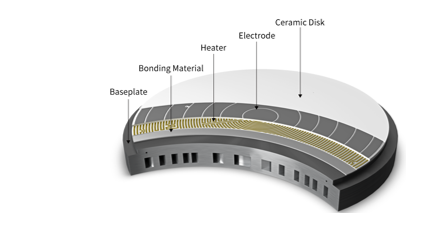
- Электростатические патроны
- Компоненты для обработки пластин
The manufacturing of semiconductor ceramic parts involves a series of highly controlled processes, including powder preparation, forming, sintering, precision machining, inspection, and surface treatment.
1. Powder Preparation
The quality of ceramic components begins with the preparation of high-purity ceramic powders.
Raw Material Formulation
The first step is selecting and mixing ultra-fine ceramic raw materials according to a specific formulation.
Depending on the material requirements, ceramic powders can be synthesized using:
- Solid-state methods
- Liquid-phase methods
- Gas-phase methods
The objective is to achieve high purity, controlled particle size distribution, and excellent chemical uniformity.
Ball Milling
Ball milling is commonly used to refine ceramic powders and improve particle uniformity.
During this process:
- Ceramic powders are loaded into a ball mill.
- Ceramic or polymer-lined milling chambers are used to minimize contamination.
- Grinding media, typically ceramic balls, are added.
Through continuous impact and friction, powder particles are reduced to micron or even submicron sizes, improving sintering performance and final material density.
Spray Drying
After powder synthesis, ceramic slurries often require washing, filtration, drying, and calcination. These processes can affect particle morphology and compositional consistency.
Spray drying offers a more controlled solution.
In this process:
- The ceramic slurry is atomized into fine droplets.
- The droplets are introduced into a stream of hot air.
- Solvent rapidly evaporates.
- Uniform spherical granules are formed.
Benefits of spray drying include:
- Consistent particle size distribution
- Improved powder flowability
- Better mold filling during forming
- Finer grain structures after sintering
2. Ceramic Forming Processes
After powder preparation, ceramic powders are shaped into “green bodies” before sintering.
Several forming technologies are commonly used depending on the geometry and performance requirements of the final component.
Сухое прессование
Dry pressing is one of the most widely used ceramic forming methods.
Process
- Granulated powder is filled into a precision metal mold.
- Pressure is applied through punches.
- Powder particles compact under load.
- A green body with sufficient strength and shape is produced.
Преимущества
- High production efficiency
- Excellent dimensional consistency
- Suitable for simple geometries
- Cost-effective for mass production
Приложения
- Керамические подложки
- Discs
- Rings
- Structural ceramic components
Изостатическое прессование
Isostatic pressing provides uniform compaction from all directions.
Process
The ceramic powder compact is placed inside a flexible mold and loaded into an isostatic press.
A liquid pressure medium is used to apply pressure uniformly throughout the component.
Since pressure is transmitted equally in every direction:
- Density distribution becomes more uniform.
- Internal stress is reduced.
- Mechanical properties are improved.
Преимущества
- Higher green density
- Improved structural integrity
- Reduced deformation during sintering
- Suitable for large or complex parts
Приложения
- Semiconductor ceramic chambers
- Large SiC components
- High-performance structural ceramics
Tape Casting
Tape casting is a specialized forming technology used for producing thin ceramic sheets.
Process
A well-dispersed ceramic slurry is continuously cast onto a carrier film through a doctor blade.
The slurry spreads evenly and forms a thin layer.
After drying:
- Solvent evaporates.
- Organic binders create a flexible network.
- Thin ceramic tapes are produced.
The tapes can then undergo:
- Cutting
- Punching
- Hole formation
- Lamination
before being fired.
Преимущества
- Thickness control from tens of microns to several millimeters
- Excellent surface flatness
- High dimensional accuracy
Приложения
- Керамические подложки
- Электронные корпуса
- Multilayer ceramic devices
- Sensor components
Ceramic Injection Molding (CIM)
Ceramic Injection Molding combines ceramic powders with polymer binders to form complex shapes.
Process
- Ceramic powder is mixed with thermoplastic binders.
- The feedstock is heated into a flowable state.
- Material is injected into a mold cavity.
- The molded part cools and solidifies.
- The green body is ejected.
Subsequent debinding and sintering produce the final ceramic component.
Преимущества
- Excellent for complex geometries
- High production efficiency
- Tight dimensional tolerances
- Automated manufacturing capability
Приложения
- Semiconductor nozzles
- Precision ceramic insulators
- Компоненты для обработки пластин
- Miniature ceramic structures
Gel Casting
Gel casting is an advanced near-net-shape forming technology suitable for complex ceramic parts.
Process
A low-viscosity ceramic slurry with high solid loading is prepared.
Organic monomers and initiators are added to the slurry.
After casting into a mold:
- Polymerization occurs in situ.
- A three-dimensional network forms.
- The slurry solidifies into a rigid body.
The green body then undergoes:
- Demolding
- Drying
- Debinding
- Sintering
to produce the final ceramic component.
Преимущества
- High green strength
- Excellent shape complexity
- Low shrinkage
- Uniform density distribution
Приложения
- Complex semiconductor ceramic components
- Large precision ceramic structures
- Customized high-performance ceramic parts
Beyond Forming: Sintering, Machining, and Surface Engineering
Although forming is a critical step, semiconductor ceramic components require additional processing before becoming finished products.
Высокотемпературное спекание
Green bodies are densified through high-temperature sintering, often exceeding:
- 1,600°C for alumina
- 1,800°C for silicon nitride
- 2,000°C or higher for certain silicon carbide materials
This process develops the ceramic’s final microstructure and mechanical properties.
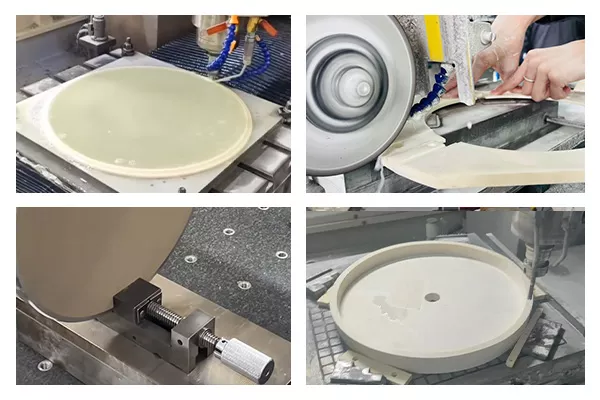
Precision Machining
Because semiconductor equipment demands micron-level accuracy, advanced machining techniques are often required, including:
- Алмазное шлифование
- Обработка на станках с ЧПУ
- Laser machining
- Ultrasonic machining
- Precision polishing
Обработка поверхности
Additional treatments may include:
- Plasma-resistant coatings
- Yttria coatings
- Полировка поверхности
- Cleaning and contamination control processes
These treatments enhance performance and extend service life in harsh semiconductor environments.
Заключение
The manufacturing of semiconductor ceramic components is a highly sophisticated process that combines materials science, powder engineering, precision forming, high-temperature sintering, and advanced machining technologies.
From ultra-pure ceramic powders to precision-finished components, every production step directly influences the performance and reliability of semiconductor equipment. As semiconductor technology continues to advance toward smaller process nodes and more demanding manufacturing environments, advanced ceramic components will remain indispensable for achieving higher precision, longer service life, and greater process stability.