
Alumina ceramic, also known as aluminum oxide ceramic or Al₂O₃ ceramic, is one of the most widely used technical ceramic materials. It offers a practical combination of electrical insulation, mechanical strength, hardness, wear resistance, thermal stability and corrosion resistance.
However, not all alumina ceramics are the same.
Commercial alumina materials are commonly identified by their nominal alumina content, such as:
- 95% alumina
- 96% alumina
- 99% alumina
- 99.5% alumina
- 99.7% alumina
- 99.9% alumina
The remaining percentage normally consists of sintering additives, glassy phases and trace impurities used to control densification, grain growth, machinability and manufacturing cost.
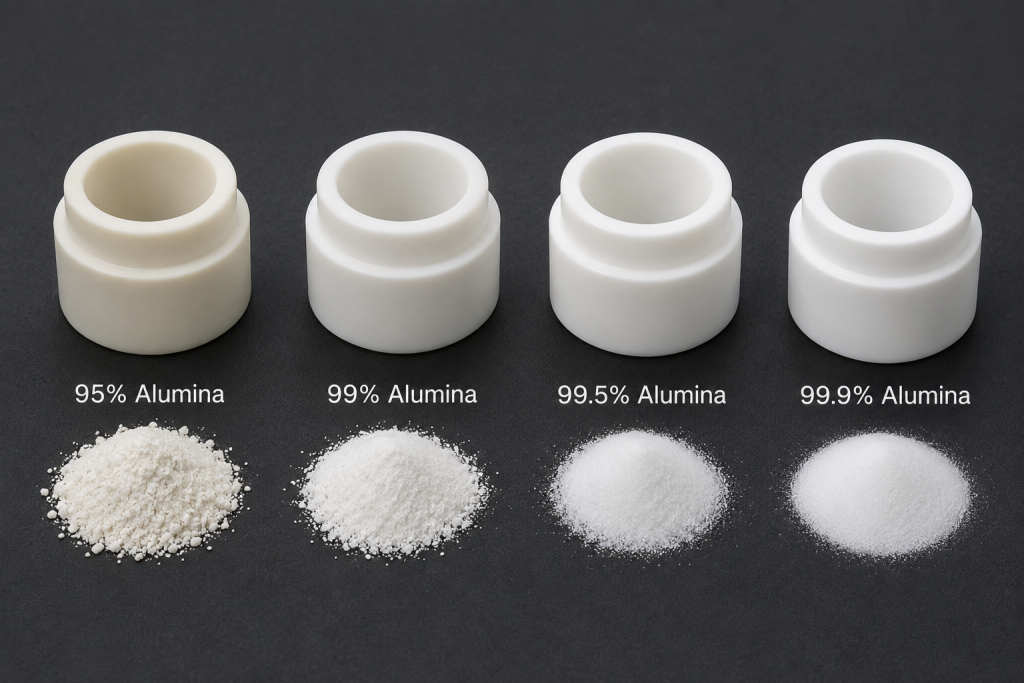
In general, increasing alumina purity can improve chemical stability, electrical insulation, high-temperature performance and resistance to plasma or process contamination. However, a higher percentage does not automatically make a ceramic component better for every application.
The correct material depends on the component’s operating temperature, mechanical load, electrical requirements, chemical environment, dimensional tolerance and cost target.
This article compares 95%, 99%, 99.5% and 99.9% alumina ceramics and explains how engineers should select the right purity level.
What Does Alumina Purity Mean?
The purity percentage describes the nominal proportion of aluminum oxide in the ceramic composition.
Zum Beispiel:
- A 95% alumina ceramic contains approximately 95% Al₂O₃.
- A 99.5% alumina ceramic contains approximately 99.5% Al₂O₃.
- The balance consists mainly of additives, secondary phases and trace impurities.
These additives are not necessarily manufacturing defects. They are often intentionally introduced to promote sintering, lower firing temperature, control microstructure or improve production efficiency.
Commercial alumina ceramics are available in compositions ranging from about 80% to more than 99%, with higher-purity grades generally providing improved wear and corrosion resistance.
The purity percentage should therefore be viewed as a material-family classification rather than a complete performance specification.
Two ceramics both labeled “99.5% alumina” may still have different:
- Grain sizes
- Densities
- Flexural strengths
- Surface finishes
- Dielectric properties
- Thermal conductivities
- Trace-element concentrations
- Plasma erosion rates
Material data from the actual supplier should always be reviewed before final design approval.
Why Are Sintering Additives Used?
Pure alumina powder requires carefully controlled processing and relatively high sintering temperatures to achieve a dense ceramic body.
Small amounts of additives may be used to:
- Promote densification
- Reduce sintering temperature
- Control grain growth
- Reduce porosity
- Improve dimensional consistency
- Support high-volume manufacturing
- Make the finished material more economical
Common secondary constituents may contain oxides based on silicon, magnesium, calcium or other elements, depending on the formulation.
After firing, these additives may form secondary crystalline phases or glassy grain-boundary phases. These phases can influence electrical insulation, corrosion resistance, thermal performance and behavior in semiconductor plasma environments.
As alumina purity increases, the proportion of these secondary phases generally decreases.
General Comparison of Alumina Purity Levels
The following table shows typical engineering trends rather than guaranteed values for every manufacturer.
| Property or Consideration | 95% Tonerde | 99% Tonerde | 99.5% Tonerde | 99.9% Alumina |
|---|---|---|---|---|
| Materialkosten | Lowest | Mäßig | Höher | Highest |
| Secondary phase content | Relatively high | Unter | Very low | Minimal |
| Elektrische Isolierung | Gut | Very good | Ausgezeichnet | Ausgezeichnet |
| Chemische Beständigkeit | Gut | Very good | Ausgezeichnet | Highest for many environments |
| Stabilität bei hohen Temperaturen | Gut | Very good | Ausgezeichnet | Ausgezeichnet |
| Abriebfestigkeit | Gut | Very good | Ausgezeichnet | Ausgezeichnet |
| Semiconductor cleanliness | Limited for critical uses | Suitable for some processes | Common high-purity option | Preferred for highly sensitive applications |
| Machining and production economy | Best | Balanced | More demanding | Most demanding |
| Typical use | General industrial components | Precision and electrical parts | Semiconductor and high-purity equipment | Ultra-high-purity and highly controlled processes |
Actual properties depend on formulation, density, porosity, grain structure and manufacturing route.
95% Alumina Ceramic
What Is 95% Alumina?
A 95% alumina ceramic contains a relatively larger amount of sintering additives and secondary phases than higher-purity grades.
It is one of the most economical engineering ceramics and is frequently selected when the application requires better wear resistance, insulation and temperature resistance than plastics or conventional metals, but does not require ultra-high chemical purity.
Die wichtigsten Vorteile
The main benefits of 95% alumina include:
- Competitive material cost
- Gute mechanische Festigkeit
- Good electrical insulation
- Gute Verschleißfestigkeit
- Good dimensional repeatability
- Ausgereifter Herstellungsprozess
- Suitability for high-volume production
- Wide range of available shapes
Because of its cost-performance balance, lower-purity alumina is often used for general mechanical and electrical components.
Alumina as a material family is widely used because it combines electrical insulation, mechanical strength, wear resistance and corrosion resistance.
Typische Anwendungen
Zu den üblichen Anwendungen gehören:
- Elektrische Isolatoren
- Textile guides
- Ceramic bushings
- Komponenten der Pumpe
- Valve parts
- Verschleißplatten
- Wire guides
- Mechanical spacers
- Ceramic rollers
- General industrial fixtures
Limitations
Compared with high-purity grades, 95% alumina may have:
- More grain-boundary glassy phase
- Lower resistance to aggressive chemicals
- Lower high-temperature electrical resistivity
- Greater risk of ionic contamination
- Lower suitability for plasma-facing semiconductor parts
- Less stable performance in ultra-high-purity processes
It should not automatically be selected for semiconductor chambers, ultra-high-vacuum systems or highly contamination-sensitive equipment simply because it is called alumina ceramic.
99% Alumina Ceramic
What Is 99% Alumina?
A 99% alumina ceramic provides a transition between general industrial grades and high-purity technical ceramics.
It contains substantially less secondary-phase material than 95% alumina while remaining more economical than many 99.5% or 99.9% formulations.
Die wichtigsten Vorteile
Zu den typischen Vorteilen zählen:
- Verbesserte Korrosionsbeständigkeit
- Better high-temperature stability
- Higher electrical insulation performance
- Reduced secondary-phase content
- Gute Verschleißfestigkeit
- Better suitability for precision components
- Balanced cost and performance
For many industrial applications, 99% alumina provides a practical compromise.
Typische Anwendungen
Potential applications include:
- Electrical feedthrough components
- High-voltage insulators
- Precision wear parts
- Chemical handling components
- Semiconductor equipment fixtures
- Vacuum system components
- Sensor housings
- Laboratory ceramic parts
- Mechanical positioning components
When Is 99% Alumina a Good Choice?
It is often appropriate when:
- 95% alumina does not offer sufficient chemical resistance
- High electrical insulation is required
- Process cleanliness matters, but ultra-high purity is unnecessary
- The component is exposed to elevated temperatures
- Cost must remain below that of the highest-purity materials
However, a 99% grade should still be reviewed carefully for semiconductor applications. Trace elements and grain-boundary composition may remain important even when nominal purity is high.
99.5% Alumina Ceramic
What Is 99.5% Alumina?
A 99.5% alumina ceramic is commonly classified as a high-purity technical ceramic.
Its reduced additive and secondary-phase content makes it suitable for demanding applications involving high temperature, electrical insulation, vacuum conditions, wear and controlled chemical environments.
Die wichtigsten Vorteile
Typical benefits include:
- Hohe Durchschlagsfestigkeit
- Hoher elektrischer spezifischer Widerstand
- Ausgezeichnete Verschleißfestigkeit
- Hohe chemische Stabilität
- Low porosity when properly sintered
- Gute Formbeständigkeit
- Reduced contamination potential
- Suitability for vacuum applications
- Better performance in many semiconductor processes
Alumina is valued for its high hardness, thermal stability, electrical insulation and corrosion resistance, including in semiconductor production and electronics applications.
Typische Anwendungen
99.5% alumina may be used for:
- Komponenten für Halbleiterausrüstung
- Wafer handling parts
- Plasma chamber fixtures
- Vacuum feedthrough insulators
- High-voltage components
- Präzisionskeramik-Wellen
- Pump and valve parts
- Analytical instrument components
- High-temperature electrical insulation
- Chemical-resistant ceramic components
Why Is It Common in Semiconductor Equipment?
Semiconductor processing requires careful control of:
- Particles
- Metal ions
- Alkali contaminants
- Chemische Korrosion
- Plasma erosion
- Outgassing
- Stabilität der Abmessungen
Reducing the amount of grain-boundary and glass-forming additives can help improve the suitability of alumina for these conditions.
However, nominal purity alone is not sufficient. Semiconductor users may also need to specify:
- Sodium concentration
- Iron concentration
- Calcium concentration
- Silicon concentration
- Bulk density
- Open porosity
- Oberflächenrauhigkeit
- Cleaning procedure
- Packaging standard
A material described only as “99.5% alumina” may not contain enough information for a contamination-sensitive application.
99.9% Alumina Ceramic
What Is 99.9% Alumina?
A 99.9% alumina ceramic contains only a very small proportion of non-alumina constituents.
It is usually selected for applications in which material purity, chemical stability and process contamination are more important than minimum manufacturing cost.
Die wichtigsten Vorteile
Potential advantages include:
- Minimal secondary-phase content
- High chemical resistance
- High-temperature electrical stability
- Low contamination potential
- Strong resistance to many process environments
- Suitability for ultra-high-purity equipment
- Improved stability in controlled plasma applications
- High wear and corrosion resistance
Higher-purity alumina grades generally provide improved wear and corrosion resistance, although actual properties remain formulation-dependent.
Typische Anwendungen
99.9% alumina may be selected for:
- Critical semiconductor chamber parts
- High-purity wafer-processing fixtures
- Plasma-exposed ceramic parts
- High-temperature furnace components
- Ultra-high-vacuum insulation
- Analytical and scientific instruments
- High-purity chemical processing
- Components used near sensitive wafers
- Specialized electronic packages
Limitations
The highest-purity option also introduces practical challenges:
- Higher raw-material cost
- More demanding sintering
- Greater process-control requirements
- Higher machining cost
- Longer production lead time
- More difficult manufacturing of complex shapes
- Potentially higher scrap rates
- Limited economic value in non-critical applications
Using 99.9% alumina for a basic wear guide may increase cost without delivering a meaningful improvement in service performance.
Does Higher Purity Always Mean Higher Strength?
Not necessarily.
It is tempting to assume that 99.9% alumina must always be mechanically stronger than 95% alumina. In practice, mechanical strength depends on multiple factors:
- Grain size
- Grain-size distribution
- Dichte
- Residual porosity
- Oberflächenbehandlung
- Edge quality
- Internal defects
- Sintering conditions
- Component geometry
- Machining damage
A well-manufactured 95% alumina component may have better usable strength than a poorly sintered or heavily damaged high-purity component.
Purity is only one part of the material specification.
For mechanically critical components, buyers should review:
- Biegefestigkeit
- Compressive strength
- Bruchzähigkeit
- Weibull modulus
- Härte
- Surface flaw limits
- Proof-testing requirements
How Purity Affects Electrical Insulation
Alumina is widely used as an electrical insulator because it provides good dielectric strength and physical stability.
As purity increases, reduced secondary-phase and ionic content can support:
- Higher volume resistivity
- Better insulation at elevated temperatures
- Lower dielectric loss
- Improved high-voltage reliability
- Better behavior in vacuum electrical systems
However, electrical properties are also affected by:
- Temperatur
- Frequency
- Humidity
- Kontamination der Oberfläche
- Component thickness
- Electrode geometry
- Grain-boundary composition
High-alumina ceramics are commonly used in hermetic electrical terminals because of their dielectric strength, mechanical strength and dense, gas-tight structure.
For high-voltage or high-frequency applications, designers should use actual measured data rather than selecting a grade solely by purity percentage.
How Purity Affects Thermal Performance
Alumina offers moderate thermal conductivity compared with metals and higher conductivity than many traditional insulating materials.
Higher purity often supports improved thermal conductivity because fewer glassy or secondary phases interrupt heat flow through the ceramic microstructure.
This makes higher-purity alumina useful for:
- Elektronische Substrate
- Leistungsmodule
- Wärmeverteiler
- Heater insulation
- Hochtemperatur-Armaturen
Commercial alumina substrates can provide useful combinations of flexural strength, thermal conductivity and dielectric strength for electronic applications.
Still, thermal conductivity can vary considerably among alumina grades. Density, grain size, temperature and additive chemistry all matter.
Where thermal management is the primary requirement, aluminum nitride may also be considered because it generally offers much higher thermal conductivity than alumina.
How Purity Affects Chemical Resistance
Higher alumina purity normally reduces the amount of glassy grain-boundary material that may be attacked by acids, alkalis or process chemicals.
As a result, high-purity grades often provide:
- Bessere Korrosionsbeständigkeit
- Lower material loss
- Less surface roughening
- Lower particle generation
- Reduced ionic leaching
- Längere Nutzungsdauer
This can be particularly important for:
- Semiconductor wet processes
- Chemical pumps
- Ventilkomponenten
- Analytical instruments
- Pharmazeutische Ausrüstung
- High-purity fluid handling
However, alumina is not chemically inert under every condition.
Its corrosion behavior depends on:
- Chemical composition
- Concentration
- Temperatur
- Pressure
- Exposure time
- Applied stress
- Surface condition
Compatibility testing may be necessary for strong acids, strong bases and aggressive plasma chemistries.
How Purity Affects Plasma Resistance
Plasma-facing ceramic components may experience:
- Chemical erosion
- Ion bombardment
- Surface roughening
- Grain pullout
- Erzeugung von Partikeln
- Contamination release
Higher-purity alumina is often preferred because it contains fewer secondary constituents that may erode selectively or introduce unwanted elements.
Nevertheless, alumina may not be the best material for every plasma chemistry.
Depending on the process, alternatives may include:
- Yttria ceramic
- Yttria-coated alumina
- Aluminum nitride
- Silicon carbide
- Quarz
- Sapphire
The correct choice depends on the plasma gas, ion energy, operating temperature and acceptable contamination profile.
How Purity Affects Surface Finish
High-purity alumina can be ground, lapped and polished to produce precision surfaces.
Potential surface requirements include:
- Controlled Ra
- Hohe Ebenheit
- Parallelism
- Low edge chipping
- Mirror polishing
- Leak-tight sealing surfaces
- Uniform wafer-contact surfaces
Surface quality does not come automatically from purity. It depends on:
- Powder quality
- Grain size
- Sintering density
- Grinding parameters
- Diamond tool selection
- Polishing process
- Edge finishing
- Reinigung
A 99.9% material with poor surface finishing may generate more particles than a properly processed 99.5% component.
Alumina Purity and Color
Alumina ceramics are commonly white, ivory or light cream, but appearance can vary.
Color differences may be caused by:
- Purity level
- Trace impurities
- Additive composition
- Grain size
- Sintering atmosphere
- Oberflächenbehandlung
- Component thickness
Color should not be used as a reliable method for determining purity.
A bright white component is not necessarily 99.9% alumina, and a slightly cream-colored component is not necessarily low quality.
Material certificates and chemical analysis provide more reliable confirmation.
Alumina Purity and Machining Cost
Alumina components are usually formed and sintered near their final shape. Critical dimensions are then produced by diamond grinding, lapping, polishing or laser processing.
Higher-purity grades may increase cost because of:
- More expensive powders
- Tighter powder control
- Higher sintering requirements
- Greater density and hardness
- More demanding grinding
- Tighter contamination control
- More specialized cleaning
- Higher inspection requirements
Cost is also strongly affected by component geometry.
Features that increase manufacturing difficulty include:
- Deep holes
- Thin walls
- Narrow slots
- Internal threads
- Small radii
- Large flat surfaces
- Tight flatness requirements
- High aspect ratios
- Mirror-polished areas
Selecting 99.9% alumina while also specifying unnecessarily tight tolerances can make a component significantly more expensive.
Which Alumina Purity Should You Choose?
Choose 95% Alumina When:
- Cost is a major consideration
- The application is general industrial use
- Good insulation and wear resistance are sufficient
- The environment is not highly corrosive
- Ultra-low contamination is unnecessary
- High-volume production is required
Choose 99% Alumina When:
- Better corrosion and electrical performance are required
- The component operates at elevated temperature
- Moderate process cleanliness is needed
- A balance between purity and cost is important
- The component is used in precision industrial equipment
Choose 99.5% Alumina When:
- The part is used in semiconductor equipment
- High electrical insulation is required
- Vacuum compatibility matters
- Chemical and wear resistance are important
- Low porosity and reduced contamination are required
- The component is close to wafers or sensitive electronics
Choose 99.9% Alumina When:
- Process contamination must be minimized
- Trace impurities are tightly controlled
- The part is exposed to aggressive plasma or chemicals
- Ultra-high-purity semiconductor processing is involved
- High-temperature electrical stability is critical
- Material cost is less important than process reliability
Information Buyers Should Confirm
Before ordering custom alumina ceramic components, it is useful to confirm:
- Nominal alumina purity
- Maximum allowable impurity levels
- Bulk density
- Open porosity
- Grain size
- Biegefestigkeit
- Härte
- Wärmeleitfähigkeit
- Coefficient of thermal expansion
- Volume resistivity
- Dielectric strength
- Maximum service temperature
- Oberflächenrauhigkeit
- Flatness and parallelism
- Dimensional tolerances
- Cleaning requirements
- Packaging requirements
For semiconductor applications, the buyer may also need:
- Trace-metal analysis
- Ion contamination limits
- Plasma erosion data
- Particle inspection
- Ultrasonic cleaning
- Cleanroom packaging
- Lot traceability
- Material certificates
Common Selection Mistakes
Selecting Only by Purity Percentage
A higher number does not replace a complete material specification.
Ignoring Process Chemistry
A ceramic suitable for dry mechanical wear may not perform well in corrosive plasma or hot alkaline solutions.
Applying Tight Tolerances Everywhere
Only functionally critical dimensions should receive the tightest tolerances.
Ignoring Surface and Edge Quality
Chips, grinding damage and sharp edges may cause failure even when the bulk material is high purity.
Assuming All Supplier Grades Are Equivalent
The same nominal purity can have different grain structures, additives and properties.
Choosing the Highest Purity Without Evaluating Cost
99.9% alumina is not always necessary. A well-selected 99% or 99.5% grade may provide better overall value.
Schlussfolgerung
The difference between 95%, 99%, 99.5% and 99.9% alumina ceramics is not limited to the amount of aluminum oxide listed on a material certificate.
Increasing purity generally reduces secondary phases and can improve:
- Chemische Beständigkeit
- Elektrische Isolierung
- Stabilität bei hohen Temperaturen
- Abriebfestigkeit
- Semiconductor process compatibility
- Contamination control
However, actual component performance also depends on powder quality, microstructure, density, grain size, porosity, surface finish and manufacturing quality.
For general industrial wear and insulation, 95% alumina may provide the best cost-performance balance. For precision electrical and chemical applications, 99% alumina is often suitable. Semiconductor, vacuum and high-purity equipment frequently use 99.5% alumina, while 99.9% grades are generally reserved for the most contamination-sensitive or chemically demanding processes.
The best approach is to match the ceramic grade to the actual operating environment instead of automatically selecting the highest available purity.
XKH Ceramics supplies custom alumina ceramic components in multiple purity grades, including precision-machined parts for semiconductor equipment, electronics, vacuum systems, chemical processing and industrial wear applications. Components can be manufactured according to customer drawings, material requirements, dimensional tolerances and surface-finish specifications.