
The rapid increase in AI computing density is changing the requirements placed on power conversion hardware.
AI servers increasingly require compact, high-efficiency power supplies, DC/DC converters, power stages and advanced thermal-management systems. As power density rises, the ceramic substrate underneath power semiconductor devices becomes increasingly important.
Two commonly considered materials are:
- Polished alumina (Al₂O₃)
- نيتريد الألومنيوم (AlN)
Both provide electrical insulation, dimensional stability and compatibility with semiconductor packaging processes.
However, they behave very differently in terms of:
- التوصيل الحراري
- Coefficient of thermal expansion
- تشطيب السطح
- Flatness
- Metallization
- Mechanical reliability
- التكلفة
Selecting between polished alumina and AlN should therefore be based on the actual thermal and packaging requirements of the power module rather than material reputation alone.
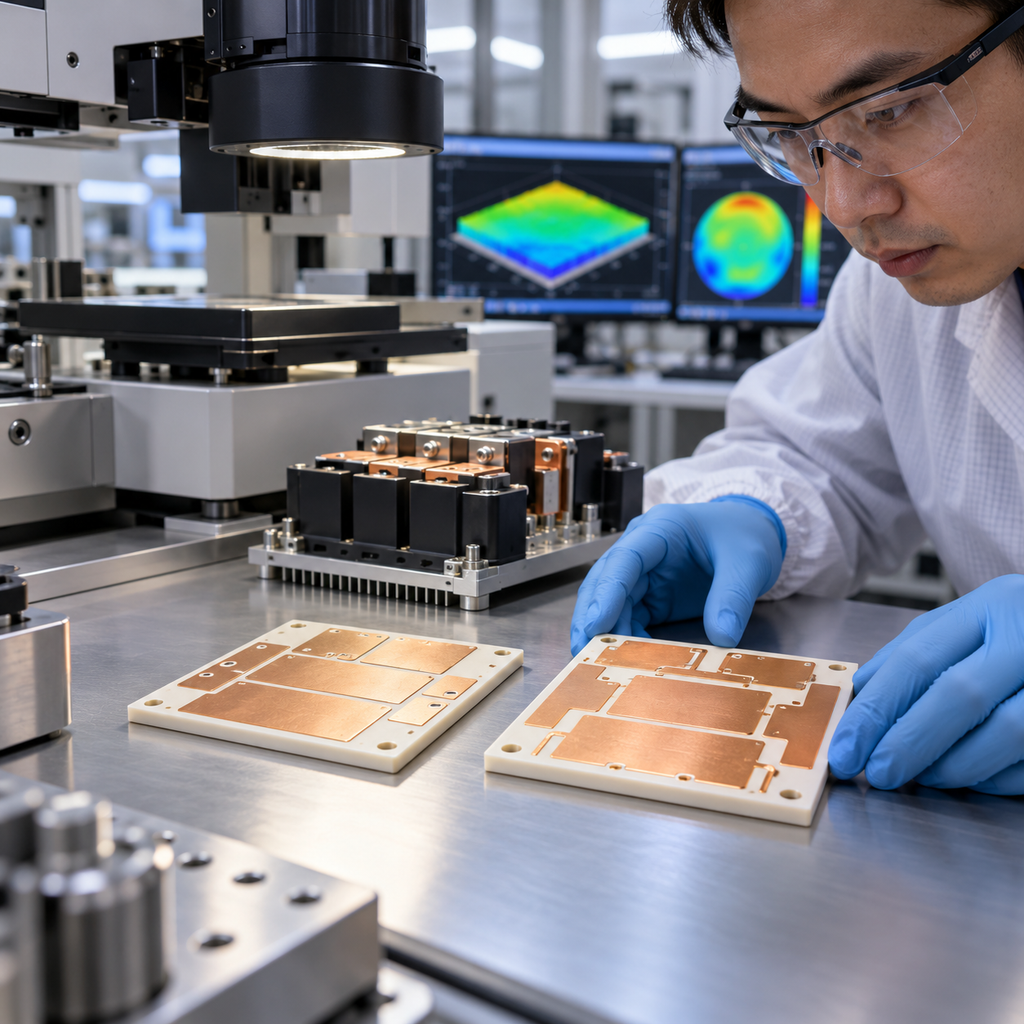
1. Why Ceramic Substrates Matter More in AI Server Power Systems
Power architecture for AI infrastructure is moving toward significantly higher power density.
Next-generation AI data centers are also moving toward higher-voltage DC distribution architectures, including 800 VDC systems, to reduce current, conversion stages and distribution losses.
This affects components such as:
- Server power supply units
- High-power DC/DC converters
- Power distribution modules
- Solid-state circuit protection
- SiC power modules
- GaN power stages
- Auxiliary power converters
As semiconductor switching performance improves, more heat can be generated in a smaller footprint.
The ceramic substrate has to perform two apparently conflicting tasks:
electrically isolate the semiconductor while efficiently transferring heat away from it.
This is where the difference between alumina and AlN becomes important.
2. Thermal Conductivity: The Largest Difference
Thermal conductivity is usually the first specification engineers compare.
Typical values for electronic-grade substrates are approximately:
| الممتلكات | Alumina Al₂O₃ | Aluminum Nitride AlN |
|---|---|---|
| التوصيل الحراري | ~24 W/m·K | ~170 W/m·K |
| CTE | ~7–9 ×10⁻⁶/K | ~5–6 ×10⁻⁶/K |
| Dielectric strength | ≥15 kV/mm | ≥15 kV/mm |
| Typical bending strength | ≥500 MPa | ≥450 MPa |
Representative CeramTec substrate specifications list thermal conductivity of approximately 24 W/m·K for alumina and 170 W/m·K for AlN, illustrating why AlN is attractive for high-power-density electronics.
The thermal conductivity of AlN can therefore be several times higher than conventional alumina.
That difference becomes important when heat must move vertically from a semiconductor die through the substrate toward:
- Copper layers
- Baseplates
- المشتتات الحرارية
- Cold plates
- Liquid-cooling structures
3. When Does AlN Actually Make a Difference?
Higher thermal conductivity does not automatically mean every AI server power module should use AlN.
The benefit depends on where the dominant thermal resistance exists.
Consider the thermal path:
Semiconductor junction → die attach → metallization → ceramic → copper/baseplate → TIM → heat sink
If the ceramic layer represents a significant percentage of total thermal resistance, changing from alumina to AlN can provide meaningful improvement.
But if the main limitation is:
- Poor die attach
- Thick thermal interface material
- Inadequate cooling
- Small heat-sink area
- Poor contact pressure
then replacing alumina with AlN may produce less improvement than expected.
Thermal simulation should therefore examine the complete stack-up.
4. AlN Is Particularly Attractive for High Heat-Flux Power Stages
AlN becomes especially interesting where several conditions occur simultaneously:
- High semiconductor power density
- Limited module footprint
- High switching frequency
- High junction temperature
- SiC or GaN devices
- Compact liquid cooling
- High continuous load
Commercial power-electronics substrates based on AlN can provide thermal conductivity around 170 W/m·K, and AlN-based metallized substrates are used specifically for high-power-density applications.
For AI server power systems, these conditions can occur in high-power conversion stages where designers are attempting to reduce:
- Module volume
- المقاومة الحرارية
- Junction temperature
- Cooling-system size
5. Why Alumina Is Still Important
If AlN conducts heat much better, why is alumina still widely used?
Because thermal conductivity is only one design variable.
Polished alumina offers several important advantages.
Mature Manufacturing
Alumina substrate manufacturing is extremely mature.
Large volumes can be produced with controlled:
- Thickness
- Flatness
- تشطيب السطح
- Dimensional tolerance
- Metallization
Cost Efficiency
Alumina is generally more economical than AlN.
For applications where heat flux remains moderate, the additional thermal performance of AlN may not justify the extra substrate cost.
Excellent Surface Quality
Fine-grain polished alumina can achieve extremely smooth surfaces suitable for precision metallization.
CeramTec specifically notes that fine alumina surfaces can support demanding thin-film processes, including sputtered metal layers and laser structuring.
This makes polished alumina attractive for applications requiring:
- Thin-film circuits
- Precision resistors
- RF structures
- Sensor circuits
- Gate-drive circuits
- Control electronics
6. Polished Alumina Is Different From Standard Alumina Substrate
The word polished is important.
Not every alumina substrate provides the same surface condition.
Standard as-fired ceramic may contain:
- Surface texture
- Grain-related topography
- Local pits
- Thickness variation
For many thick-film applications, this may be acceptable.
But thin-film metallization can require significantly better surfaces.
Precision polishing can improve:
- خشونة السطح
- Local flatness
- Metal-film continuity
- Photolithography consistency
- Fine-line patterning
Therefore, an RFQ should not simply specify:
“96% alumina substrate.”
Surface requirements should also be defined.
7. Surface Roughness Becomes Important for Thin-Film Metallization
Thin-film processes may use materials such as:
- Ti
- TiW
- Cr
- Ni
- Cu
- Au
These films may be deposited using:
- Sputtering
- Evaporation
- PVD
When metallization thickness becomes small, the ceramic surface underneath strongly influences the resulting conductor.
Excessive roughness can contribute to:
- Non-uniform film thickness
- Fine-line variation
- Poor adhesion consistency
- Photolithography difficulties
- Increased conductor defects
For these applications, polished alumina can remain highly competitive even when maximum thermal conductivity is not required.
8. AlN Can Also Be Polished
AlN should not be considered a rough, thermal-only substrate.
Precision AlN substrates can also be:
- Ground
- Lapped
- Polished
- Laser machined
- Metallized
For high-end power semiconductor packaging, suppliers can control:
- Thickness
- TTV
- Bow
- Warp
- خشونة السطح
- Edge quality
However, producing high-flatness, highly polished AlN generally requires tighter process control and may increase cost.
This makes specification optimization important.
Do not request optical-level polishing if the metallization process does not require it.
9. Flatness Is Critical for Power Module Assembly
Thermal conductivity receives most of the attention, but flatness can be equally important during module manufacturing.
A substrate that is not sufficiently flat can create problems during:
- Die attach
- تلبيد الفضة
- Soldering
- Baseplate attachment
- Heat-sink mounting
Excessive bow may produce uneven bond-line thickness.
That can lead to:
- Thermal hot spots
- Bonding voids
- Local stress
- Poor contact
- Assembly yield loss
Rogers notes that substrate bending is a critical parameter during die assembly and later attachment to baseplates or heat sinks. Bending is affected by substrate dimensions, aspect ratio, copper layout and ceramic/copper thickness.
10. Flatness and Bow Are Not Only Ceramic Problems
When investigating substrate warpage, engineers should not automatically blame the ceramic.
The finished assembly is a composite structure.
على سبيل المثال:
Copper / Ceramic / Copper
Each layer has different:
- Thickness
- Elastic modulus
- التمدد الحراري
- Residual stress
An asymmetric copper pattern can cause the complete substrate to bend.
Factors affecting finished-substrate bow include:
- Ceramic thickness
- Copper thickness
- Copper coverage
- Circuit symmetry
- Substrate length
- Substrate width
- Metallization process
- Thermal history
Therefore, ceramic flatness should be specified both before and, where necessary, after metallization.
11. CTE Is Another Advantage of AlN
Coefficient of thermal expansion becomes increasingly important when mounting semiconductor dies directly onto ceramic-based substrates.
Representative substrate data shows approximately:
- الألومينا: 7–9 ppm/K
- AlN: 5–6 ppm/K
AlN therefore has a thermal expansion behavior closer to many semiconductor materials.
Rogers similarly reports AlN DBC CTE around 4.7 ppm/K in one commercial substrate system.
A closer CTE match may help reduce thermo-mechanical stress in:
- Solder layers
- Sintered silver
- Semiconductor dies
- Metallization interfaces
This becomes particularly valuable during repeated power cycling.
12. Metallization Options for Alumina
Alumina supports a wide range of metallization technologies.
Depending on circuit requirements, these may include:
Thick-Film Metallization
Screen-printed conductive pastes can be fired directly onto alumina.
تشمل التطبيقات النموذجية ما يلي:
- Hybrid circuits
- Resistors
- Sensors
- Control modules
Thin-Film Metallization
Polished alumina is particularly suitable for sputtered thin-film systems.
This enables:
- Fine conductor lines
- Precision circuits
- High-density interconnects
DBC
Direct Bond Copper is widely used when thick copper conductors and high current capability are required.
DBC forms a strong copper-to-ceramic interface and is an established technology for power electronics.
13. Metallization Options for AlN
AlN can also support multiple metallization technologies.
These include:
- Thin-film metallization
- Thick-film systems designed for AlN
- DBC
- AMB
However, bonding copper directly to non-oxide ceramics requires different interface chemistry.
Rogers notes that conventional DBC naturally works with oxide ceramics such as alumina, while AlN requires surface treatment/oxidation for DBC or can be joined using Active Metal Brazing.
This distinction is important when comparing manufacturing cost and process complexity.
14. DBC vs AMB for AlN
Two common solutions for high-current power modules are:
AlN DBC
و
AlN AMB
DBC uses a high-temperature bonding process to create a copper/ceramic structure.
AMB uses an active brazing system that enables bonding to non-oxide ceramics.
The ideal choice depends on:
- Copper thickness
- Ceramic thickness
- Thermal cycling requirements
- Circuit geometry
- Reliability requirements
- Supplier process capability
The metallization technology should therefore be specified together with the ceramic material.
15. Copper Thickness Also Changes Thermal Performance
When discussing ceramic thermal conductivity, engineers sometimes overlook the copper layer.
Power substrates may contain relatively thick copper to provide:
- High current capacity
- Heat spreading
- Mechanical interconnection
Commercial ceramic power substrates can use copper layers in the hundreds-of-micrometers range.
This means overall thermal performance depends on the full structure:
Copper thickness + ceramic thickness + interface quality
not simply the ceramic thermal conductivity listed in the material datasheet.
16. Metallization Adhesion Should Be Qualified
For AI server power modules that experience repeated temperature changes, metallization reliability is critical.
Qualification may evaluate:
- Peel strength
- Interface voids
- التدوير الحراري
- Metallization thickness
- Pattern dimensional accuracy
- تلوث السطح
- Edge condition
A substrate with excellent thermal conductivity provides little value if the copper-to-ceramic interface fails during service.
17. Thermal Cycling Can Change the Material Decision
AlN has outstanding thermal conductivity, but material selection must consider mechanical reliability as well.
Ceramic/copper assemblies experience stress during repeated heating and cooling because copper and ceramic expand differently.
Published power-electronics substrate studies and manufacturer guidance emphasize that thermal cycling performance depends not only on the ceramic material but also on copper thickness, ceramic thickness, geometry and bonding technology.
This is another reason not to select a substrate based on thermal conductivity alone.
18. Alumina May Be the Better Choice When
Polished alumina can be a good choice when:
- Heat generation is moderate
- Substrate cost is sensitive
- Thin-film metallization is required
- Extremely smooth surfaces are important
- The substrate contains control or sensing circuitry
- Mature high-volume sourcing is preferred
- Thermal resistance elsewhere dominates the system
Typical applications may include:
- Gate-drive modules
- Monitoring circuits
- Sensor electronics
- Auxiliary power circuits
- Lower-power converters
19. AlN May Be the Better Choice When
AlN becomes more attractive when:
- Heat flux is high
- Power density is increasing
- Semiconductor junction temperature is critical
- SiC or GaN devices are used
- Module size must be reduced
- Cooling area is limited
- Ceramic thermal resistance is a bottleneck
- CTE matching is important
Potential applications include:
- High-power DC/DC modules
- High-density server PSUs
- SiC power stages
- High-frequency power conversion
- Compact liquid-cooled power modules
20. Do Not Select the Material Before Defining the Stack-Up
For custom power electronics substrates, the RFQ should ideally define the complete structure.
Important information includes:
- Ceramic material
- Ceramic purity or grade
- Substrate length and width
- Thickness
- Thickness tolerance
- TTV
- Flatness
- Bow
- Warp
- خشونة السطح
- Metallization material
- Metallization thickness
- Circuit pattern
- Minimum line width
- Minimum spacing
- Edge metallization
- Via requirements
- Operating voltage
- درجة حرارة التشغيل
- Power dissipation
- Cooling method
Without this information, comparing substrate quotations can become misleading.
21. Suggested Incoming Inspection
For precision AI power-module substrates, incoming inspection may include:
Ceramic Geometry
Measure:
- Length
- Width
- Thickness
- TTV
- Flatness
- Bow
- Warp
Surface Quality
Inspect:
- Scratches
- Chips
- Edge defects
- تلوث السطح
- Polishing marks
Metallization
Verify:
- Metal thickness
- Pattern dimensions
- Registration
- Adhesion
- Surface condition
For metallized power substrates, additional inspection may include interface quality and thermal-performance evaluation.
22. Alumina vs AlN: Practical Selection Table
| Requirement | Polished Alumina | AlN |
|---|---|---|
| التوصيل الحراري | معتدل | عالية جداً |
| تلميع السطح | ممتاز | Excellent with proper processing |
| Thin-film compatibility | ممتاز | ممتاز |
| Thick-film compatibility | Mature | متوفرة |
| DBC compatibility | ممتاز | Available with suitable process |
| AMB compatibility | متوفرة | ممتاز |
| CTE match to semiconductor | معتدل | أفضل |
| High heat-flux capability | معتدل | ممتاز |
| التكلفة | أقل | أعلى |
| High-volume availability | ممتاز | جيد |
| Typical use | Cost-sensitive / moderate power | High-power-density modules |
The table should be treated as a starting point rather than a universal material ranking.
23. Why AI Power Electronics May Increase AlN Demand
The important industry change is not simply that AI servers consume more power.
The architecture of power delivery itself is changing.
Higher rack power, higher-voltage DC distribution, increased use of wide-bandgap semiconductors and more aggressive liquid cooling all encourage designers to reduce thermal resistance and increase power density.
That environment strengthens the case for materials such as AlN.
But it does not eliminate alumina.
Instead, ceramic substrates are likely to become more application-specific:
Polished alumina for cost-sensitive, precision-metallized and moderate-thermal-load circuits
و
AlN for high-heat-flux, high-density power conversion.
24. Information to Provide When Requesting a Custom Ceramic Substrate
To obtain a useful quotation, provide:
- التطبيق
- Alumina or AlN preference
- Substrate dimensions
- Thickness
- الكمية
- Required thermal conductivity
- خشونة السطح
- Flatness
- TTV
- Metallization system
- Metal thickness
- Pattern drawing
- Operating voltage
- درجة حرارة التشغيل
- Semiconductor type
- Cooling configuration
If the material has not yet been selected, thermal-load information can help the ceramic supplier evaluate both alumina and AlN options.
الخاتمة
For AI server power modules, the choice between polished alumina and aluminum nitride should not be reduced to a single thermal-conductivity number.
AlN offers a major thermal advantage and a CTE closer to semiconductor materials, making it particularly attractive for compact, high-power-density SiC and GaN power stages.
Polished alumina remains highly competitive when cost, surface quality, fine metallization and manufacturing maturity are more important than maximum heat conduction.
The correct substrate therefore depends on the complete package:
Thermal load → Ceramic thickness → Flatness → Metallization → Cooling → Reliability
As AI power density continues to increase, substrate suppliers will increasingly need to control not only ceramic composition but also polishing, dimensional tolerances, metallization and finished-substrate warpage.
الأسئلة الشائعة
Is AlN always better than alumina for AI server power modules?
No. AlN provides much higher thermal conductivity, but polished alumina can be more economical and is highly suitable for precision thin-film metallization and moderate-power applications. The best material depends on total thermal resistance and module design.
How much higher is the thermal conductivity of AlN than alumina?
Representative commercial electronic ceramic data lists approximately 170 W/m·K for AlN compared with around 24 W/m·K for alumina, although actual values depend on ceramic grade and manufacturing process.
Can AlN substrates be metallized with copper?
Yes. AlN can be used with DBC under suitable processing conditions and is also compatible with Active Metal Brazing (AMB). The correct method depends on copper thickness, reliability and module design requirements.