As semiconductor devices continue to become smaller, faster, and more powerful, the materials used in semiconductor manufacturing equipment must meet increasingly demanding performance requirements. Traditional metals and polymers often struggle to withstand extreme temperatures, corrosive chemicals, plasma environments, and ultra-clean processing conditions.
This is where semiconductor ceramics play a critical role.
Advanced ceramic materials combine exceptional thermal stability, electrical insulation, mechanical strength, wear resistance, and chemical durability, making them indispensable in semiconductor fabrication, power electronics, and advanced packaging technologies.
Today, semiconductor ceramics are widely used in wafer processing equipment, plasma chambers, vacuum systems, electronic substrates, sensors, and next-generation power devices.
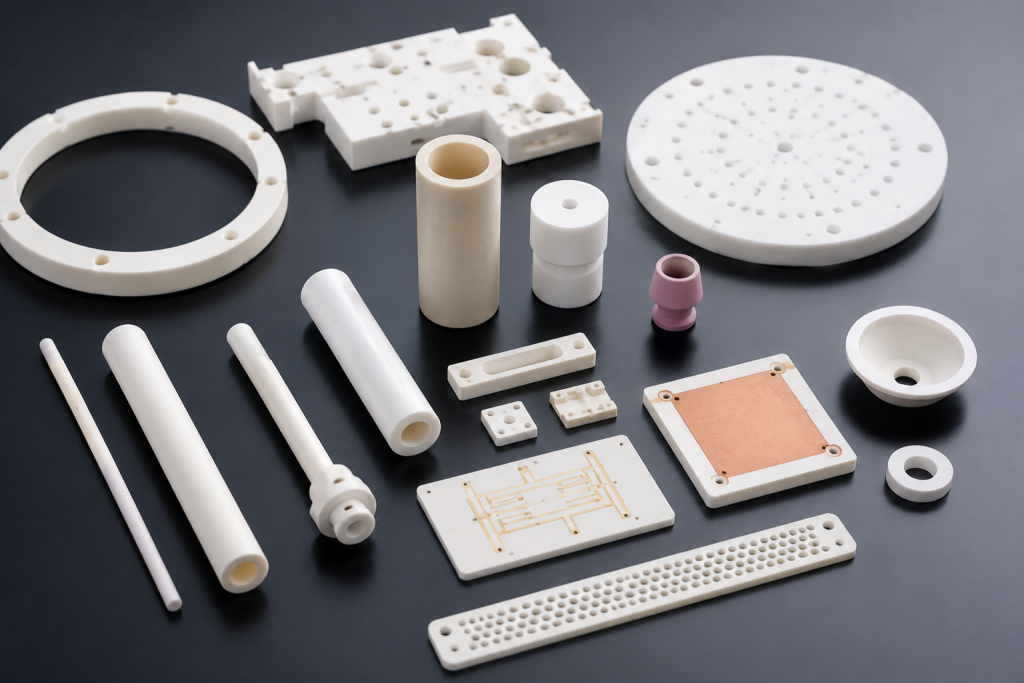
What Are Semiconductor Ceramics?
Semiconductor ceramics belong to a broader category of advanced engineering ceramics manufactured from highly purified inorganic compounds under tightly controlled processing conditions.
Unlike conventional ceramic products, advanced ceramics feature:
- High purity raw materials
- Fine-grained microstructures
- Precise dimensional control
- Specialized electrical and thermal properties
These characteristics allow ceramic materials to perform reliably in environments where conventional materials would rapidly degrade.
Key Properties of Semiconductor Ceramics
High Temperature Resistance
Many semiconductor processes operate at temperatures above 1000°C.
Advanced ceramics maintain structural integrity under extreme heat while exhibiting minimal thermal expansion.
Typical advantages include:
- Excellent thermal stability
- Resistance to thermal shock
- High melting temperatures
- Long service life in furnace environments
Electrical Insulation
Many ceramic materials possess excellent dielectric properties.
Benefits include:
- High electrical resistivity
- Stable insulation performance
- Low dielectric loss
- Resistance to electrical breakdown
These properties are essential for plasma processing equipment and electronic packaging applications.
Chemical Resistance
Semiconductor manufacturing involves exposure to aggressive process gases and chemicals.
Ceramic materials can withstand:
- Reactive plasma environments
- Corrosive process gases
- Acidic and alkaline cleaning chemicals
- High-temperature oxidation
This resistance helps reduce contamination and extend component life.
Mechanical Strength and Wear Resistance
Ceramics typically offer:
- High hardness
- Excellent abrasion resistance
- Superior compressive strength
- Dimensional stability
These characteristics make them suitable for precision semiconductor equipment components.
Major Ceramic Materials Used in Semiconductor Industry
Silicon Carbide (SiC)
Silicon carbide is one of the most important semiconductor ceramic materials.
Key properties include:
- Exceptional hardness
- High thermal conductivity
- Excellent plasma resistance
- Superior thermal shock resistance
Applications:
- Wafer susceptors
- Etching chamber components
- Semiconductor equipment parts
- Power semiconductor substrates
As wide-bandgap semiconductor technology advances, silicon carbide is increasingly used both as a structural ceramic and as a semiconductor substrate material.
Aluminum Oxide (Al₂O₃)
Alumina ceramics are among the most widely used engineering ceramics.
Advantages:
- Excellent electrical insulation
- Good mechanical strength
- Chemical stability
- Cost-effective manufacturing
Applications:
- Ceramic substrates
- Vacuum feedthroughs
- Semiconductor insulators
- Electronic packaging
High-purity alumina ceramics are commonly used in semiconductor equipment requiring reliable electrical isolation.
Aluminum Nitride (AlN)
Aluminum nitride combines electrical insulation with exceptionally high thermal conductivity.
Benefits:
- Thermal conductivity up to 170–220 W/m·K
- Low thermal expansion
- Excellent dielectric properties
Applications:
- LED packaging
- Power modules
- Semiconductor heat sinks
- High-power electronic substrates
AlN has become a preferred material for thermal management in advanced electronic systems.
Silicon Nitride (Si₃N₄)
Silicon nitride offers one of the best combinations of strength and toughness among ceramic materials.
Characteristics:
- High fracture toughness
- Excellent wear resistance
- Thermal shock resistance
- Long-term reliability
Applications:
- Precision bearings
- Semiconductor handling systems
- Mechanical components
- High-performance structural parts
Functional Ceramics in Electronics
In addition to structural ceramics, modern electronics also rely heavily on functional ceramic materials.
Piezoelectric Ceramics
Piezoelectric ceramics convert mechanical energy into electrical energy and vice versa.
Applications include:
- Ultrasonic sensors
- Medical imaging equipment
- Precision actuators
- Ignition systems
These materials form the foundation of many sensing and control technologies.
Transparent Ceramics
Transparent ceramics combine optical transmission with exceptional durability.
Common materials include:
- Transparent alumina
- Yttria-based ceramics
- Aluminum oxynitride (ALON)
Applications:
- Optical windows
- Laser systems
- Infrared imaging
- Aerospace sensors
Compared with conventional glass, transparent ceramics provide significantly higher mechanical strength and thermal stability.
Semiconductor Ceramics and the Future of Electronics
The semiconductor industry continues to push toward:
- Artificial intelligence
- Electric vehicles
- 5G and 6G communications
- High-performance computing
- Renewable energy systems
These technologies require materials capable of operating under increasingly demanding electrical and thermal conditions.
Advanced ceramic materials such as silicon carbide, aluminum nitride, and silicon nitride are becoming essential building blocks for next-generation semiconductor manufacturing and electronic devices.
As device performance requirements continue to rise, semiconductor ceramics will play an even greater role in enabling innovation across the global electronics industry.
Conclusion
Semiconductor ceramics have evolved from simple insulating materials into critical enabling technologies for modern electronics and semiconductor manufacturing.
Through their unique combination of thermal stability, electrical insulation, chemical resistance, mechanical strength, and thermal management capabilities, advanced ceramic materials help improve equipment reliability, manufacturing efficiency, and device performance.
From silicon carbide process components to aluminum nitride thermal substrates, semiconductor ceramics are helping shape the future of advanced electronics.