Ceramics are often described as electrical insulators, but this description is incomplete.
In semiconductor equipment, electronics manufacturing, vacuum systems, wafer handling, and precision automation, ceramic components may be required to perform very different electrical functions. Some components must provide extremely high electrical insulation. Others need controlled semiconductive behavior to prevent static charge accumulation. Certain silicon carbide ceramics can even be engineered to provide substantially lower electrical resistivity.
This means 陶瓷材料 selection should not be based simply on whether a material is “conductive” or “insulating.”
Engineers need to consider electrical resistivity together with thermal conductivity, mechanical strength, temperature, plasma exposure, surface condition, and electrostatic discharge requirements.
This guide compares four important groups:
- 氧化鋁 (Al2O3)
- 氮化鋁 (AlN)
- 碳化矽 (SiC)
- ESD-safe ceramics
and explains how their electrical properties affect component selection.

Electrical Conductivity vs Electrical Resistivity
Electrical conductivity describes how easily electric current passes through a material.
Electrical resistivity describes the opposite: how strongly the material resists electrical current.
For technical ceramics, engineers frequently specify volume resistivity rather than conductivity.
A high volume resistivity means the ceramic behaves as a strong electrical insulator.
A lower resistivity allows electrical charge to move through the material more easily.
This distinction becomes especially important in semiconductor equipment.
A ceramic can fall roughly into one of several functional categories:
Electrical insulating ceramic
Designed to prevent current flow.
Static-dissipative or semiconductive ceramic
Designed to allow accumulated charge to leak away gradually.
Electrically conductive ceramic
Designed to provide significantly lower resistance where controlled current flow is required.
The boundaries between these categories depend on the application and measurement standard.
1. Alumina: The Standard Electrical Insulating Ceramic
Alumina, or Al2O3, is one of the most widely used engineering ceramics.
Its combination of electrical insulation, mechanical strength, wear resistance, chemical stability, manufacturability, and relatively economical cost makes it suitable for a very broad range of industrial applications. Kyocera describes alumina as a widely used ceramic with high electrical insulation and mechanical strength.
典型的應用包括
- 電絕緣體
- 半導體設備元件
- 陶瓷基板
- Feedthrough components
- Vacuum components
- Heater supports
- Mechanical positioning parts
- 晶圓處理元件
Electrical Behavior of Alumina
Standard high-purity alumina is an excellent electrical insulator.
Some commercial alumina grades have room-temperature volume resistivity greater than 10¹⁴ Ω·cm, although actual values depend on purity, microstructure, temperature, additives, and manufacturing process.
This makes alumina suitable when electrical isolation is one of the primary design requirements.
However, electrical resistance normally decreases as temperature rises.
For components operating at elevated temperatures, engineers should therefore evaluate resistivity at the actual operating temperature rather than relying only on room-temperature data.
Thermal Conductivity of Alumina
One limitation of alumina is that its thermal conductivity is significantly lower than that of high-performance aluminum nitride.
For example, Kyocera lists approximately 29 W/(m·K) for one representative 99% alumina grade, while actual values vary by formulation and purity.
Therefore, alumina is often a good choice when:
electrical insulation + mechanical reliability + cost efficiency
are more important than maximum heat dissipation.
2. Aluminum Nitride: Electrical Insulation with High Thermal Conductivity
Aluminum nitride is particularly important in applications where engineers need two properties that can be difficult to obtain simultaneously:
high electrical insulation
和
high thermal conductivity.
Kyocera specifically describes AlN as a ceramic combining high thermal conductivity with electrical insulation and notes its use in semiconductor equipment and heat-dissipation applications.
Why AlN Is Important
Heat-generating semiconductor devices require a path for thermal energy to escape.
A metal can conduct heat efficiently, but it also conducts electricity.
Traditional insulating materials may provide electrical isolation but trap too much heat.
AlN helps solve this problem.
Certain commercial AlN substrate materials can reach thermal conductivity in the approximate range of 170–230 W/(m·K), depending on grade and manufacturing process.
That is substantially higher than typical alumina.
Typical AlN Applications
AlN is commonly considered for:
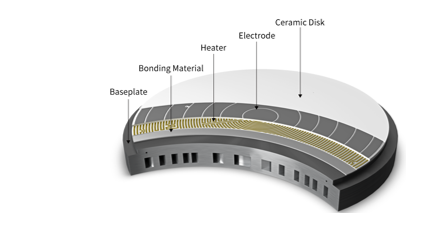
- Semiconductor heaters
- 高功率電子基板
- Laser diode submounts
- 電源模組
- 散熱片
- 半導體加工設備
- High-temperature electrically isolated components
AlN’s coefficient of thermal expansion is also relatively close to silicon compared with some other ceramic materials, which can help reduce thermal stress in certain electronic assemblies.
When Should AlN Replace Alumina?
AlN should not automatically replace alumina simply because its thermal conductivity is higher.
Alumina may still be preferred where:
- Thermal load is moderate
- Cost sensitivity is high
- Complex machining is required
- Existing processing is already qualified
- Mechanical and chemical requirements favor alumina
AlN becomes more attractive when removing heat while maintaining electrical isolation is a critical design requirement.
3. Silicon Carbide: Very Different Electrical Behavior
Silicon carbide is significantly different from alumina and aluminum nitride.
It should not automatically be treated as a conventional electrical insulator.
Depending on composition and manufacturing process, SiC ceramics can exhibit very different electrical resistivities.
Manufacturers can tailor SiC formulations and processing to produce significantly different electrical behavior. CoorsTek specifically notes that the volume resistivity of silicon carbide can be adjusted through manufacturing control.
This makes the statement:
“SiC is conductive”
or
“SiC is insulating”
too simplistic for engineering specification.
Different SiC Grades Behave Differently
Electrical characteristics may vary with:
- SiC purity
- Grain structure
- Sintering additives
- Free silicon content
- Dopants
- 孔隙率
- Manufacturing process
- 溫度
Common SiC families can include:
- 燒結碳化矽
- Reaction-bonded SiC
- Silicon-infiltrated SiC
- 再結晶 SiC
- CVD SiC
- Electrically engineered SiC grades
Each can behave differently.
Therefore, engineers should never specify only:
Material: SiC
when electrical behavior is important.
The required volume resistivity should also be stated.
4. Why SiC Is Useful in Semiconductor Equipment
SiC offers a combination of:
- 高硬度
- 耐磨性
- 耐腐蝕性
- High-temperature strength
- 熱穩定性
that makes it useful for demanding semiconductor and industrial environments.
Possible components include:
- 晶圓船
- 晶圓載具
- 製程室元件
- Heater components
- 終端效應器
- 支撐結構
- 精密平台
- Polishing components
For electrically sensitive applications, however, material grade selection becomes critical.
Two SiC components with nearly identical dimensions and appearance may have very different electrical characteristics.
5. What Are ESD-Safe Ceramics?
In semiconductor manufacturing, extremely high electrical resistance is not always desirable.
A completely insulating surface can accumulate static charge through:
- Wafer contact
- 摩擦
- 機器人搬運
- Film movement
- Component separation
- Vacuum handling processes
If that charge suddenly discharges, sensitive electronic devices may be damaged.
這是 ESD-safe ceramics become useful.
Instead of acting as perfect electrical insulators, these ceramics are engineered to dissipate static charge gradually.
CoorsTek describes ESD-safe ceramics as materials designed to protect sensitive microelectronic components by slowly dissipating accumulated static charge.
6. How ESD-Safe Ceramics Work
An ESD-safe ceramic usually sits electrically between a conventional insulator and a highly conductive material.
Its resistance is controlled so that static charge does not remain indefinitely on the surface.
At the same time, the material should not be so conductive that charge flows too rapidly.
The goal is:
controlled charge dissipation.
One approach is to modify a ceramic with conductive or semiconductive phases.
For example, Kyocera describes ESD-protection zirconia produced by adding a conductive material to zirconia to create controlled semiconductive behavior.
A commercial ESD zirconia tweezer material is listed with surface resistivity around 10⁸–10⁹ Ω, illustrating the static-dissipative range used in some practical electronic handling applications.
The correct resistance range, however, must always be determined according to the actual equipment and ESD specification.
7. Where ESD-Safe Ceramics Are Used
典型的應用包括
半導體晶圓處理
Robotic parts that repeatedly contact wafers can generate static charge.
ESD-safe ceramic contact surfaces can help dissipate accumulated charge.
Electronic Component Handling
Small semiconductor devices and sensitive electronics can be damaged by electrostatic discharge.
Ceramic:
- Tweezers
- Guides
- Fixtures
- Positioning pins
- Handling tools
can therefore use semiconductive materials.
Hard Disk and Precision Electronics Manufacturing
Controlled electrical resistance can reduce static attraction of particles while protecting sensitive components.
Vacuum Equipment
Static charge can behave differently in low-pressure environments.
Proper resistivity control may therefore become an important part of component design.
8. Alumina vs AlN vs SiC vs ESD Ceramic
A simplified comparison can help with preliminary material selection.
| 材質 | Typical Electrical Function | 熱傳導 | 關鍵優勢 |
|---|---|---|---|
| Al2O3 | Strong insulator | 中度 | Cost-effective electrical insulation |
| AlN | Strong insulator | 非常高 | Heat dissipation + insulation |
| SiC | Grade dependent | 高 | Thermal, mechanical and chemical performance |
| ESD-safe ceramic | Controlled semiconductive/static dissipative | Grade dependent | Controlled static charge dissipation |
This table should only be used as a starting point.
Actual electrical properties must be confirmed using the exact ceramic grade.
9. Do Not Select Ceramics by Electrical Resistivity Alone
Electrical behavior is only one part of ceramic component design.
A semiconductor equipment component may simultaneously require:
- 電氣絕緣
- 熱傳導
- 等離子電阻
- 耐化學性
- 高剛性
- 微粒生成量低
- 高尺寸精度
- 耐磨性
- 低熱膨脹
These requirements can conflict.
例如:
Alumina may provide excellent electrical insulation but insufficient heat transfer for a high-power application.
AlN may solve the thermal problem but increase material and manufacturing cost.
SiC may provide excellent thermal and mechanical performance but require closer control of electrical resistivity.
An ESD-safe ceramic may solve static charge problems but needs to maintain stable resistance throughout the component and over its operating environment.
Material selection must therefore consider the entire operating condition.
10. Temperature Has a Major Influence
Ceramic electrical resistivity is temperature dependent.
A material that behaves as a very strong insulator at room temperature may show significantly lower resistance at elevated temperature.
This is particularly important for:
- 陶瓷加熱器
- 火爐裝置
- High-temperature semiconductor processes
- 電力電子
- 真空設備
- 等離子處理設備
When requesting material data, engineers should specify the required resistance at the actual operating temperature whenever possible.
Room-temperature values alone may not be sufficient.
11. Surface Resistivity vs Volume Resistivity
These two specifications should not be confused.
體積電阻率
Volume resistivity describes electrical resistance through the body of the material.
It is particularly important when current may pass through the entire ceramic component.
Surface Resistivity
Surface resistivity describes charge movement across the material surface.
This can be especially important for ESD applications.
Surface condition may be affected by:
- Roughness
- 污染
- 濕度
- Cleaning chemistry
- Deposited films
- 製程殘留物
Therefore, ESD performance should sometimes be evaluated after the component has undergone the intended cleaning and operating process.
12. Electrical Uniformity Matters
For precision semiconductor components, average resistivity may not be enough.
Engineers may also need to understand whether electrical properties are uniform throughout the ceramic.
Local variations can potentially influence:
- Electrostatic behavior
- Charge dissipation
- Heating
- 晶圓處理
- Sensor response
- 製程穩定性
This becomes particularly important for customized semiconductive ceramics.
The RFQ should therefore specify whether the customer requires:
- Nominal resistivity
- Allowed resistivity range
- Surface resistivity
- Volume resistivity
- Measurement temperature
- Lot-to-lot consistency
- Position-to-position uniformity
13. Ceramic Electrical Property RFQ Checklist
When requesting a custom electrically functional ceramic component, provide as much of the following information as possible:
材質
Al2O3, AlN, SiC, ESD-safe ceramic, or other ceramic.
Required Electrical Function
Specify whether the component should be:
- Electrically insulating
- Semiconductive
- Static dissipative
- Electrically conductive
Electrical Resistance
Provide the required:
- Volume resistivity
- Surface resistivity
- Measurement method
- Test voltage
- Test temperature
where applicable.
操作溫度
Electrical properties may change significantly with temperature.
Thermal Requirements
Specify:
- 熱傳導
- Maximum temperature
- 熱循環
- Heat dissipation requirements
Mechanical Requirements
Include:
- Dimensions
- 公差
- 平整度
- 並行性
- 表面粗糙度
- Strength requirements
Process Environment
Describe exposure to:
- Plasma
- Vacuum
- 化學品
- 反應氣體
- High temperature
- Cleaning chemicals
整潔
For semiconductor equipment, specify requirements for:
- Metallic contamination
- 粒子產生
- Surface cleanliness
- 包裝
- 清潔
14. Which Ceramic Should You Choose?
For applications primarily requiring electrical insulation at reasonable cost, alumina is often the first material to evaluate.
For applications requiring electrical insulation combined with very high thermal conductivity, AlN is often a stronger candidate.
For components requiring high thermal performance, high stiffness, wear resistance, chemical resistance or high-temperature performance, SiC may be considered—but its electrical resistivity must be specified according to grade.
For wafer handling and electronic manufacturing environments where static accumulation is a concern, ESD-safe ceramics may provide controlled charge dissipation while retaining the mechanical and chemical advantages of technical ceramics.
There is no single best ceramic.
The correct material depends on the combination of:
electrical + thermal + mechanical + chemical + dimensional requirements.
常見問題
Is alumina ceramic electrically conductive?
Standard high-purity alumina is normally a strong electrical insulator. Some commercial grades have room-temperature volume resistivity above 10¹⁴ Ω·cm, although actual performance varies with material grade, temperature and processing.
Is aluminum nitride electrically conductive?
Standard AlN ceramics are generally electrical insulators while providing unusually high thermal conductivity. This combination is one reason AlN is widely used for semiconductor substrates, heaters and heat-dissipating components.
Is silicon carbide electrically conductive?
It depends on the SiC grade. Manufacturing process, composition and microstructure can produce substantially different volume resistivities, so electrical performance should be specified rather than assuming all SiC behaves the same way.
What is an ESD-safe ceramic?
An ESD-safe ceramic is engineered to dissipate accumulated electrostatic charge in a controlled manner instead of allowing charge to remain on an insulating surface. Such materials are used in semiconductor and electronics manufacturing equipment.
Is ESD-safe ceramic the same as conductive ceramic?
Not necessarily. Many ESD-safe ceramics are designed to be semiconductive or static dissipative rather than highly conductive. Their purpose is usually controlled charge dissipation.
Which ceramic is best for semiconductor equipment?
It depends on the component. Alumina is commonly chosen for insulation and structural applications, AlN for electrically insulating components requiring high heat transfer, SiC for demanding thermal and mechanical environments, and ESD-safe ceramics where controlled static dissipation is required. Fine ceramics are widely used across wafer handling, heaters, chucks and other semiconductor-processing equipment.
總結
Electrical behavior should be treated as a design parameter when selecting technical ceramics.
Alumina provides excellent conventional electrical insulation.
氮化鋁兼具電絕緣性與極高的熱導率。.
Silicon carbide provides highly useful thermal, mechanical and chemical properties, but its electrical behavior can vary substantially according to material grade and manufacturing method.
ESD-safe ceramics occupy another important category, providing controlled electrical resistance to prevent static charge accumulation around sensitive semiconductor and electronic components.
For custom ceramic parts, the most effective RFQ does not simply specify a material name.
It defines the required electrical function, resistivity range, operating temperature, thermal requirements, dimensions, surface finish, cleanliness level and process environment.
This allows the ceramic material and manufacturing process to be selected according to the actual equipment requirements rather than relying on generic material properties.