
As semiconductor fabs move more high-volume thermal processes to 300mm wafers, wafer boat condition becomes increasingly important to process stability.
A wafer boat may appear to be a simple furnace consumable, but it performs several critical functions at the same time: maintaining wafer spacing, supporting wafers during high-temperature processing, preserving loading accuracy, minimizing contact damage, and avoiding additional particle or metallic contamination.
After hundreds or thousands of thermal and loading cycles, however, the condition of a wafer boat gradually changes.
Process deposits may accumulate. Wafer slots may wear. Surface roughness can increase. Coatings may deteriorate. Repeated cleaning can alter critical contact areas. Eventually, a boat that still looks usable may begin contributing to particle excursions, wafer scratches, loading errors or process instability.
For 300mm semiconductor furnaces, maintenance therefore should not be based only on whether the boat is visibly broken.
A more effective strategy combines slot inspection, particle monitoring, cleaning history, dimensional control and defined end-of-life criteria.
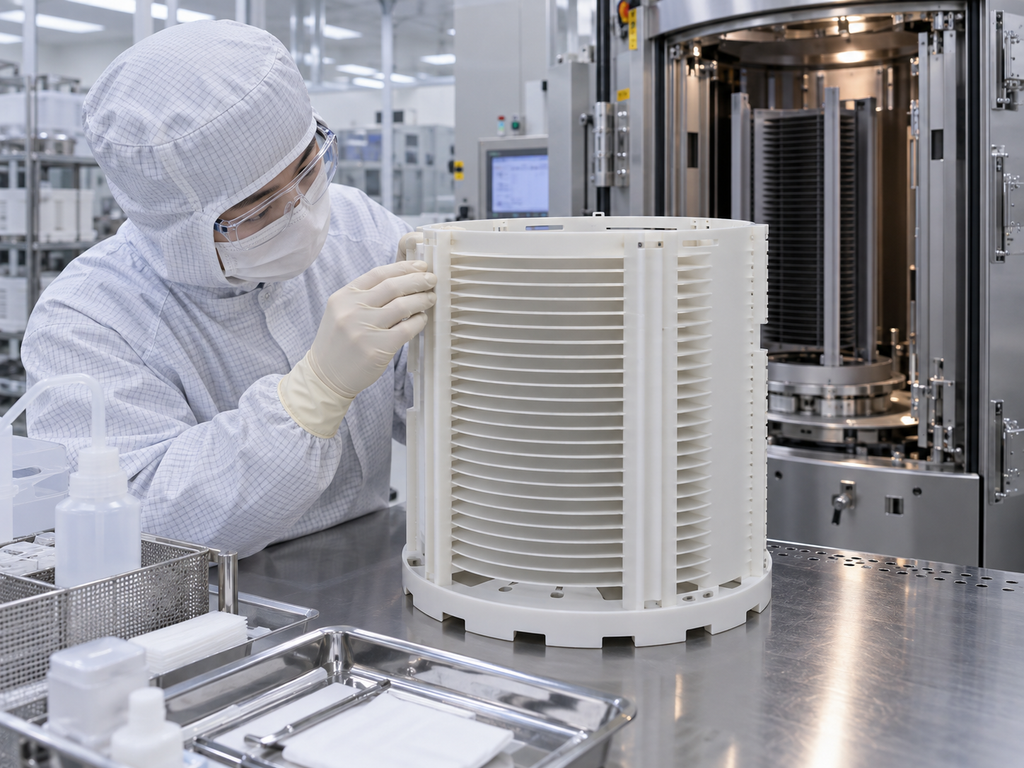
Why 300mm Wafer Boats Require More Careful Maintenance
A 300mm silicon wafer is considerably larger and heavier than smaller wafer formats.
At the same time, modern furnace systems often rely on automated wafer loading and tightly controlled wafer-to-wafer spacing.
This means relatively small changes in the wafer boat can have significant consequences.
Important risks include:
- wafer edge scratching;
- slot-to-slot positioning errors;
- wafer tilting;
- wafer sticking during loading or unloading;
- increased particle generation;
- abnormal wafer contact;
- contamination from process deposits;
- local deformation;
- broken wafers;
- robot loading failures.
For this reason, the maintenance program for a 300mm wafer boat should consider both cleanliness and mechanical condition.
Cleaning alone cannot restore a boat whose slot geometry or structural integrity has already deteriorated.
1. Main Sources of Particles from a 300mm Wafer Boat
When particle counts increase after furnace processing, the wafer boat is one of several possible sources that should be investigated.
Particles associated with the boat generally originate from four mechanisms.
Process Film Accumulation
During repeated oxidation, diffusion, LPCVD, annealing or deposition cycles, material may gradually accumulate on surfaces exposed to the furnace environment.
Depending on the process, residues can include:
- silicon-containing films;
- oxide deposits;
- nitride deposits;
- dopant-related residues;
- reaction by-products;
- trace contaminants.
Thin and well-adhered deposits may initially cause little difficulty.
As the accumulated film becomes thicker, however, differences in thermal expansion between the deposit and the wafer boat can create mechanical stress during repeated heating and cooling cycles.
Eventually, the deposited layer may crack or flake.
These fragments can become a particle source inside the furnace.
Slot Contact Wear
The wafer slot is one of the most important areas to inspect.
Every loading cycle creates contact between the wafer edge and the support points inside the slot.
Over time, repeated contact can produce:
- polished wear marks;
- scratches;
- micro-chipping;
- increased surface roughness;
- damaged slot edges;
- local changes in slot geometry.
Once a contact surface becomes damaged, particle generation may accelerate.
Cleaning-Related Surface Damage
Cleaning removes contamination, but an unsuitable cleaning process can also shorten wafer boat life.
Possible causes include:
- overly aggressive chemistry;
- excessive cleaning time;
- abrasive mechanical treatment;
- unsuitable ultrasonic conditions;
- poor rinsing;
- contamination from cleaning fixtures;
- uncontrolled drying.
A successful cleaning process should therefore remove deposits while minimizing changes to critical wafer-contact surfaces.
Structural or Coating Degradation
Depending on the wafer boat material and construction, thermal cycling can gradually affect the component.
For coated SiC components, coating damage can become particularly important.
Inspection should look for:
- peeling;
- delamination;
- cracks;
- pinholes;
- exposed substrate;
- localized discoloration;
- abnormal roughness.
Once a protective surface becomes unstable, continued cleaning may no longer be sufficient.
2. Why Slot Wear Is Especially Important for 300mm Wafers
The slot performs three basic functions:
- locating the wafer;
- supporting the wafer during furnace processing;
- maintaining a defined distance between wafers.
A small dimensional change may therefore affect both mechanical handling and process uniformity.
Important slot parameters include:
| Parameter | Why It Matters |
|---|---|
| Slot pitch | Controls wafer-to-wafer spacing |
| Slot width | Influences loading clearance |
| Slot depth | Determines wafer seating |
| Slot angle | Influences wafer orientation |
| Edge radius | Affects wafer contact and scratching |
| Ytjämnhet | Influences friction and particle generation |
| Slot position | Important for robotic loading |
| Slot-to-slot consistency | Affects batch stability |
For new wafer boats, these dimensions should be defined on the engineering drawing.
For used boats, selected dimensions should be periodically rechecked against the original specification or qualified reference part.
3. What Does Slot Wear Look Like?
Slot deterioration is not always obvious.
A cracked slot is easy to identify, but early-stage wear may appear only as a change in surface texture.
Common signs include:
Shiny Contact Marks
Repeated wafer contact can polish certain areas.
A small, stable contact mark is not necessarily a failure.
However, if the polished area becomes progressively wider or asymmetric, the wafer may no longer be contacting the slot as originally designed.
Micro-Chipping
Small chips near the slot entrance or support point can become particle sources.
They may also create a sharp surface capable of damaging the wafer edge.
Roughened Contact Surfaces
Process deposits and repeated cleaning can gradually alter surface roughness.
A rough contact area may trap contamination and increase friction during wafer loading.
Slot Widening
Mechanical wear or repeated cleaning can gradually change slot width.
This can affect wafer positioning and increase movement during furnace loading.
Uneven Wear Between Positions
It is also important to compare different locations along the wafer boat.
If top, middle and bottom regions show different wear patterns, this may indicate:
- loading misalignment;
- temperature distribution effects;
- gas-flow differences;
- robot positioning issues;
- nonuniform process deposition.
For this reason, inspection should not be limited to a single representative slot.
4. Build a Slot Wear Map Instead of Relying Only on Visual Inspection
For high-value 300mm processes, a useful maintenance method is to establish a slot wear map.
Divide the boat into zones such as:
- upper;
- upper-middle;
- center;
- lower-middle;
- lower.
Then inspect several defined slots within each zone.
The inspection record can include:
- slot width;
- visible deposits;
- chipping;
- surface condition;
- contact mark size;
- crack status;
- abnormal discoloration;
- particle accumulation.
Photographs can also be stored for comparison.
Over several cleaning cycles, this creates a history of how the component is aging.
Instead of asking:
“Is this boat still usable?”
the fab can ask:
“Is the degradation rate changing, and is the boat approaching the qualified limit?”
That distinction is important for preventive maintenance.
5. Cleaning Windows Should Be Process-Based, Not Calendar-Based
There is no universal rule such as “clean every X days” that works for every semiconductor furnace.
The required cleaning frequency depends strongly on:
- process chemistry;
- deposition rate;
- furnace temperature;
- number of wafer loads;
- process film;
- required particle level;
- material of the wafer boat;
- cleaning chemistry;
- product sensitivity.
Two identical wafer boats used in different processes may therefore require very different maintenance intervals.
A more useful concept is the cleaning window.
The cleaning window defines how much process exposure a qualified boat can receive before cleaning is required.
It may be based on:
- furnace cycle count;
- cumulative deposition thickness;
- number of processed wafers;
- particle trend;
- wafer defect data;
- historical process performance.
Avoid Cleaning Too Early
Cleaning more frequently than necessary increases:
- chemical exposure;
- labor cost;
- equipment downtime;
- handling risk.
It may also accelerate surface degradation.
Avoid Cleaning Too Late
Waiting until deposits become excessive increases the risk of:
- film flaking;
- particles;
- difficult residue removal;
- slot blockage;
- wafer handling problems.
The goal is therefore not maximum cleaning frequency.
It is the longest validated cleaning interval that maintains acceptable process performance.
6. Monitor Particle Excursions Before Replacing the Boat
An increase in particles does not automatically mean the wafer boat has reached end of life.
Particle excursions should be investigated systematically.
Useful questions include:
- Did the particle level change immediately after boat installation?
- Did the increase appear after a specific number of furnace cycles?
- Is contamination concentrated near particular wafer positions?
- Did the problem appear after cleaning?
- Has the process chemistry recently changed?
- Are the deposits visible on slot surfaces?
- Is the furnace tube itself contaminated?
- Has robot alignment changed?
- Are the same particles observed on monitor wafers?
This approach helps distinguish wafer-boat degradation from other possible contamination sources.
7. Cleaning Inspection: Before and After
Every major cleaning cycle should ideally include two inspections.
Before Cleaning
Record:
- deposition condition;
- visible particles;
- discoloration;
- cracked areas;
- chipped slots;
- surface peeling;
- slot blockage;
- deformation.
This information helps identify whether cleaning is appropriate or whether replacement should already be considered.
After Cleaning
Verify:
- deposits have been removed;
- no chemical residue remains;
- slots remain dimensionally acceptable;
- surfaces have not become excessively rough;
- no new chips appeared;
- coatings remain intact;
- the component is correctly dried and packaged.
The comparison between pre-clean and post-clean condition can reveal whether the cleaning process itself is contributing to degradation.
8. Purity Requirements Should Match the Furnace Process
“High purity” by itself is not a sufficient wafer boat specification.
The acceptable impurity level depends on the semiconductor process.
A purchasing specification may need to address:
- raw material grade;
- trace metal content;
- open porosity;
- coating purity;
- surface contamination;
- cleaning procedure;
- packaging condition.
Potential contaminants of concern can include:
- Fe;
- Ni;
- Cr;
- Cu;
- Na;
- Ca;
- Al;
- other process-sensitive elements.
The required control level should be defined according to the customer’s contamination budget.
Not every furnace process requires the same purity level.
Over-specifying the component can unnecessarily increase cost, while under-specifying it can create yield risk.
9. Quartz vs SiC: Maintenance Behavior Is Different
Quartz and silicon carbide are both widely used in semiconductor furnace environments, but their aging mechanisms are not identical.
Quartz Wafer Boats
Quartz offers excellent chemical purity and is widely established in furnace processing.
During long-term high-temperature service, however, dimensional stability, surface condition and accumulated process films must be monitored carefully.
SiC Wafer Boats
SiC offers high mechanical strength, high-temperature stability and good resistance to many harsh process environments.
Depending on the SiC grade, the boat may be:
- sintered SiC;
- reaction-bonded SiC;
- CVD SiC;
- SiC-coated composite structures.
The cleaning and end-of-life criteria should therefore consider the exact construction.
For coated products, coating integrity becomes an additional inspection item.
Material selection should be based on the actual furnace temperature, chemistry, contamination limits and expected maintenance cycle rather than simply selecting one material as universally superior.
10. When Should a 300mm Wafer Boat Be Replaced?
There should ideally be documented replacement criteria instead of relying only on operator judgment.
Typical end-of-life indicators include:
Cracked Structural Areas
Cracks may propagate during future thermal cycles and create both mechanical and particle risks.
Chipped Wafer Contact Points
Damage in the wafer-support area can scratch wafers or produce particles.
Slot Geometry Outside Specification
If slot pitch, width, position or other critical dimensions exceed the qualified limits, cleaning will not restore the original geometry.
Persistent Particle Problems
If particle performance remains unacceptable after validated cleaning, replacement should be investigated.
Severe Surface Roughening
A heavily degraded surface may retain more process residue and become more difficult to clean.
Coating Failure
For coated components, significant peeling, cracking or exposed substrate may indicate end of life.
Dimensional Deformation
Straightness, parallelism and critical interface dimensions must remain compatible with the furnace and robotic loading system.
Repeated Cleaning Failure
If each cleaning cycle produces shorter usable life before the next contamination excursion, the component may be approaching the end of its economical service life.
11. Use Trend Data Instead of a Fixed Maximum Cycle Count
A supplier can provide general material information, but the actual lifetime of a wafer boat depends heavily on the customer’s process.
For this reason, defining a universal value such as:
“This boat lasts exactly 500 cycles”
is usually not technically meaningful without process qualification.
A better maintenance database records:
| Uppgifter | Purpose |
|---|---|
| Boat serial number | Component traceability |
| Installation date | Lifetime tracking |
| Furnace ID | Process correlation |
| Process type | Chemistry correlation |
| Cycle count | Exposure history |
| Cleaning count | Maintenance history |
| Particle results | Contamination trend |
| Slot inspection | Mechanical trend |
| Repair history | Component condition |
| Replacement reason | Future lifetime optimization |
Once enough data has been collected, the fab can establish realistic preventive replacement limits for each process.
12. Replacement Boat Qualification
Replacing a worn boat is not simply a matter of ordering another component with the same overall dimensions.
For a 300mm replacement project, buyers should confirm:
- wafer diameter;
- furnace model or interface;
- vertical or horizontal configuration;
- number of slots;
- slot pitch;
- slot width;
- slot depth;
- wafer contact geometry;
- overall dimensions;
- straightness;
- critical tolerances;
- operating temperature;
- process atmosphere;
- material grade;
- purity requirement;
- surface finish;
- coating requirement;
- cleaning requirements.
When the original drawing is unavailable, an existing qualified component may be measured to generate a replacement drawing.
However, heavily used parts should be treated carefully because measured dimensions may already include wear.
Whenever possible, measurements should be compared with the original equipment specification.
13. What to Include in an RFQ for a Custom 300mm Wafer Boat
A clear RFQ reduces unnecessary technical communication and quotation delays.
Recommended information includes:
Wafer Size:
300 mm
Application:
Oxidation / diffusion / LPCVD / annealing / other furnace process
Material:
Quartz / SiC / CVD SiC / other specified grade
Wafer Capacity:
Required number of wafers
Slot Pitch:
Specified drawing value
Slot Dimensions:
Width, depth and profile where critical
Overall Dimensions:
According to equipment interface
Operating Temperature:
Maximum process temperature
Process Atmosphere:
Relevant process gases where disclosure is permitted
Purity Requirement:
Material and contamination requirements
Surface Finish:
Critical wafer-contact areas if specified
Quantity:
Prototype and production quantities
Reference:
Engineering drawing, STEP file, sample or inspection report
Providing this information allows the supplier to evaluate manufacturability, material selection and inspection requirements more accurately.
VANLIGA FRÅGOR
How often should a 300mm wafer boat be cleaned?
There is no universal cleaning interval. Cleaning should be based on the actual furnace process, deposition rate, particle trends, cycle count and qualified contamination limits.
Can a wafer boat be reused after cleaning?
Yes, provided the component remains within the required mechanical, dimensional and contamination limits. Cleaning cannot correct structural cracks, severe slot wear or unacceptable deformation.
What part of a wafer boat usually requires the most attention?
Wafer-contact slots are among the most important areas because they experience repeated mechanical contact and can accumulate process deposits.
How do I know whether a wafer boat should be cleaned or replaced?
Cleaning is appropriate when contamination is removable and the component remains structurally and dimensionally acceptable. Replacement should be considered when cracks, slot damage, deformation, coating failure or persistent contamination exceed the qualified limits.
Can a worn 300mm wafer boat be copied for replacement?
Yes, reverse engineering from a sample may be possible. However, measurements should account for existing wear. Original drawings or equipment specifications are preferable whenever available.
What information should I send for a custom wafer boat quotation?
Provide wafer size, material, slot count, slot pitch, overall dimensions, operating temperature, process application, purity requirement, surface requirements, quantity and an engineering drawing or reference sample where possible.
Slutsats
For 300mm semiconductor furnace processes, wafer boat maintenance should be treated as a controlled part of process equipment management rather than simple consumable cleaning.
The most effective maintenance program combines:
- particle monitoring;
- slot wear inspection;
- dimensional verification;
- controlled cleaning;
- material and purity management;
- cycle history;
- component traceability;
- defined replacement criteria.
Cleaning can restore a contaminated wafer boat, but it cannot restore damaged geometry or structural integrity.
By monitoring degradation trends instead of waiting for obvious failure, semiconductor manufacturers can establish more predictable cleaning windows, reduce particle excursions and determine when replacement is more economical than continued maintenance.
For custom or replacement 300mm wafer boats, the most useful starting information is the wafer size, slot configuration, furnace process, operating temperature, material requirement, critical dimensions and drawing or reference sample.