
Electric-vehicle powertrains are changing the requirements placed on bearings.
A conventional vehicle transmission is largely mechanical.
An electric eAxle integrates:
- high-speed electric motor;
- reduction gearbox;
- inverter;
- differential;
- bearings.
As manufacturers increase motor speed to reduce motor size and weight, bearing rotational speeds are rising sharply.
In June 2026, JTEKT announced a grease-lubricated ceramic-ball bearing designed for high-performance EV eAxles with operation up to 30,000 rpm. The company specifically highlighted ceramic rolling elements as a way to reduce electrical corrosion while supporting higher-speed operation.
This development illustrates why silicon nitride ceramic balls are becoming increasingly important in electric mobility.
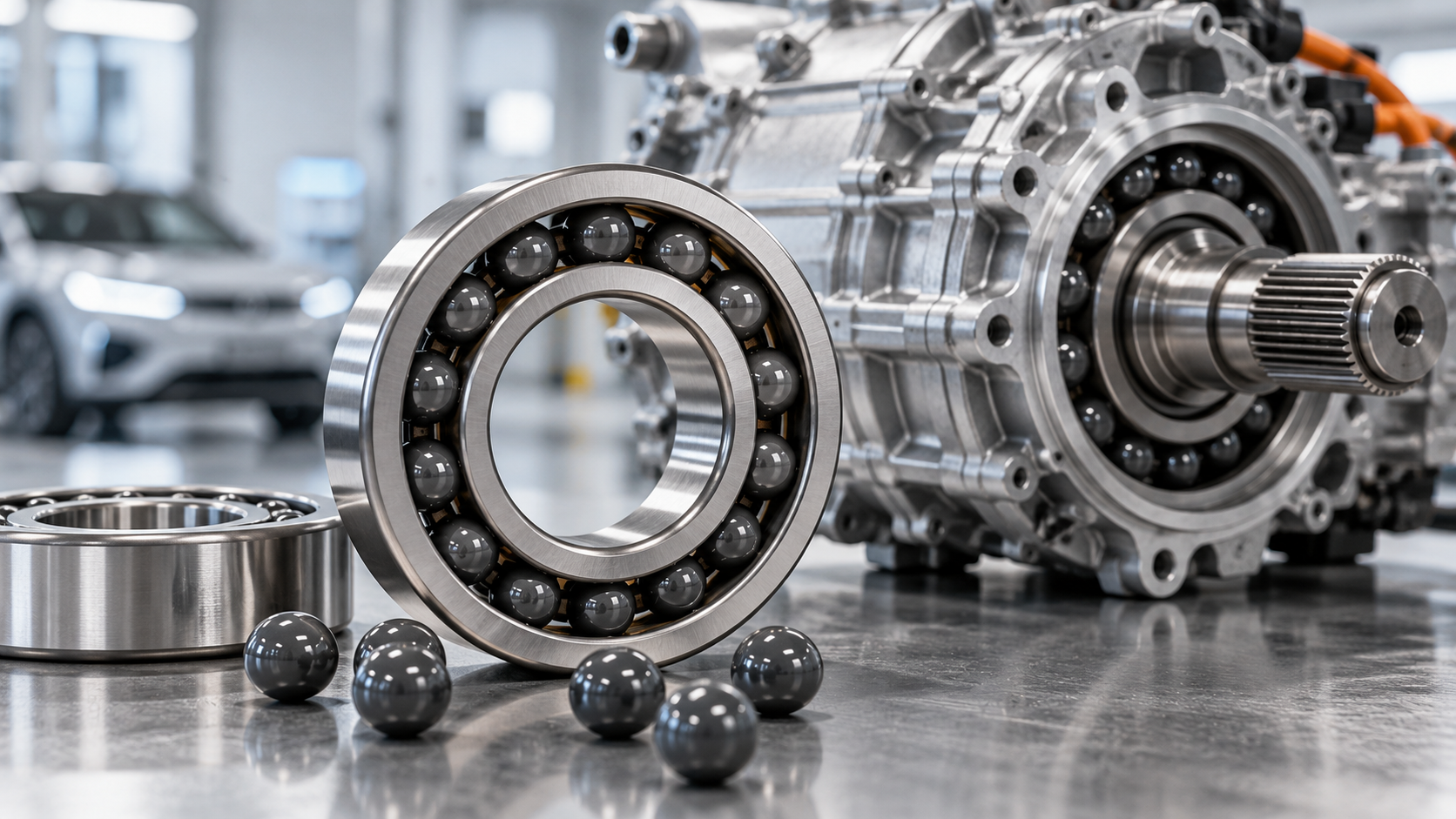
Why EV Bearings Face Electrical Damage
Electric motors use high-frequency inverter switching.
This can create shaft voltage.
If sufficient electrical potential develops across a bearing, current may discharge through the lubricating film between the rolling elements and raceways.
Repeated electrical discharge can create:
- microscopic craters;
- frosting;
- fluting;
- lubricant degradation;
- vibration;
- premature bearing failure.
This phenomenon is often referred to as electrical erosion or electrical corrosion.
Using electrically insulating ceramic rolling elements can interrupt the current path.
Why Silicon Nitride Is Used
Silicon nitride, or Si₃N₄, combines several useful properties:
- electrical insulation;
- low density;
- high hardness;
- high compressive strength;
- good fracture toughness for a ceramic;
- wear resistance;
- thermal stability.
Compared with steel balls, silicon nitride balls are significantly lighter.
This matters at high rotational speed.
Centrifugal force increases rapidly with speed, so reducing rolling-element mass can reduce dynamic loading.
Lower Mass Becomes More Important at 30,000 rpm
At relatively low bearing speeds, the density difference between ceramic and steel rolling elements may not dominate system behavior.
At very high speeds, it becomes much more important.
A lighter ceramic ball generates less centrifugal force against the outer race.
Potential benefits include:
- reduced friction;
- lower heat generation;
- reduced raceway loading;
- improved acceleration response;
- improved high-speed capability.
This is one reason hybrid ceramic bearings have become attractive for high-speed electric motors.
What Is a Hybrid Ceramic Bearing?
A hybrid bearing normally combines:
steel inner and outer rings + silicon nitride ceramic balls.
This architecture uses ceramic where its properties provide the greatest benefit without manufacturing the entire bearing from ceramic.
The steel rings provide mature raceway manufacturing and high structural toughness.
Si₃N₄ balls provide:
- electrical insulation;
- reduced moving mass;
- high hardness;
- dimensional stability.
Ceramic Ball Quality Is Critical
A bearing may contain only a small number of ceramic balls, but each ball repeatedly contacts the raceway at extremely high Hertzian contact stress.
The ceramic must therefore have excellent internal quality.
Os possíveis defeitos incluem:
- pores;
- inclusions;
- agglomerates;
- machining damage;
- surface pits;
- microcracks.
A small defect can become the origin of rolling-contact failure.
For this reason, high-performance Si₃N₄ bearing balls require tightly controlled powder processing, sintering and finishing.
Surface Finish Matters
The final ceramic ball must be precision ground and polished.
Important specifications can include:
- diameter;
- roundness;
- surface roughness;
- ball grade;
- lot diameter variation;
- surface-defect limits.
The surface should minimize local stress concentration while providing stable lubricant behavior.
A visually smooth ceramic sphere is not necessarily a bearing-grade ceramic ball.
Subsurface integrity matters as well.
Why Grease Lubrication Is Interesting
Oil lubrication is often used when bearing speed becomes extremely high because it provides continuous cooling and lubrication.
Grease systems are simpler.
They can reduce:
- pumps;
- pipes;
- oil circulation hardware;
- sealing complexity.
Achieving 30,000 rpm under grease lubrication therefore has potential system-level benefits.
The bearing itself, cage, seals and grease formulation all need to be optimized together.
Si₃N₄ Is Expanding Beyond Traditional Bearings
Silicon nitride ceramic bearings are already used in:
- machine-tool spindles;
- aerospace systems;
- high-speed motors;
- vacuum equipment;
- semiconductor equipment.
EV eAxles add a potentially much larger-volume market.
As electric motors move toward higher speed and 800 V architectures, electrical isolation and high-speed stability become increasingly valuable.
Material Selection Is Only the Beginning
A high-quality Si₃N₄ ball depends on the entire production route:
powder preparation → forming → sintering → HIP or densification → grinding → lapping → polishing → inspection.
Density, grain structure, secondary phases and surface damage all affect the final bearing performance.
For custom technical-ceramic projects, customers should specify not just “silicon nitride” but also:
- target density;
- strength;
- hardness;
- surface quality;
- dimensional tolerance;
- intended load;
- operating speed;
- temperature;
- lubrication environment.
The eAxle market demonstrates how advanced ceramics are increasingly moving from specialized industrial applications into high-volume mobility systems.