Em sectores de engenharia avançada, como os semicondutores, as máquinas de precisão e os sistemas ópticos, cerâmica industrial, carboneto de silício (SiC) e safira são frequentemente comparados como materiais concorrentes.
No entanto, esta comparação é enganadora se for tratada como uma simples questão de “qual é o melhor”.
Um entendimento mais correto é:
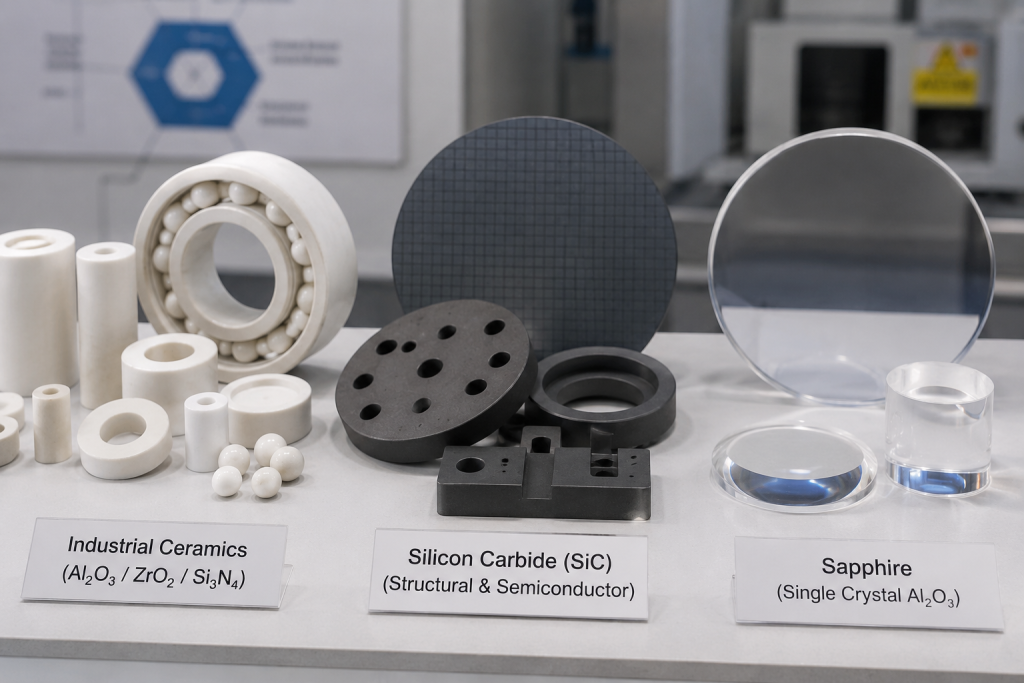
Estes três materiais representam três arquitecturas de materiais diferentes, e não apenas três níveis de desempenho.
- Cerâmica industrial → sistemas policristalinos de engenharia
- Carboneto de silício → material funcional de desempenho extremo
- Safira → material monocristalino de qualidade ótica
Pertencem a diferentes “filosofias de conceção de materiais” e não apenas a diferentes famílias de materiais.
1. Cerâmica industrial: A camada de base da engenharia
A cerâmica industrial refere-se a uma vasta classe de materiais policristalinos, incluindo
- Cerâmica de alumina
- Cerâmica de zircónio
- Cerâmica de nitreto de silício
- Cerâmicas de SiC sinterizadas por reação
Conceito principal: Materiais de troca concebidos
A cerâmica industrial não se define por um desempenho extremo, mas sim por..:
otimização de engenharia equilibrada entre custo, maquinabilidade e durabilidade
Caraterísticas típicas:
- Elevada resistência ao desgaste
- Boa resistência à corrosão
- Isolamento elétrico
- Resistência mecânica moderada a elevada
- Relativamente eficaz em termos de custos
Função industrial:
- Rolamentos
- Vedantes mecânicos
- Carris de guia
- Bicos
- Componentes estruturais
2. Carboneto de silício (SiC): O material para ambientes extremos
O carboneto de silício situa-se na fronteira entre a cerâmica e os materiais semicondutores funcionais.
É única porque serve dois sectores de atividade:
(1) SiC estrutural (componentes de engenharia)
Utilizado em:
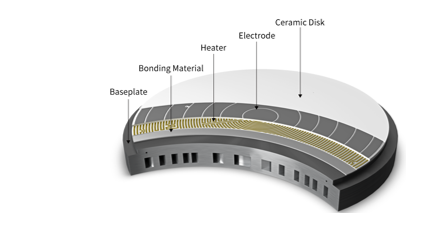
- Mandris de vácuo para semicondutores
- Peças da câmara de gravura
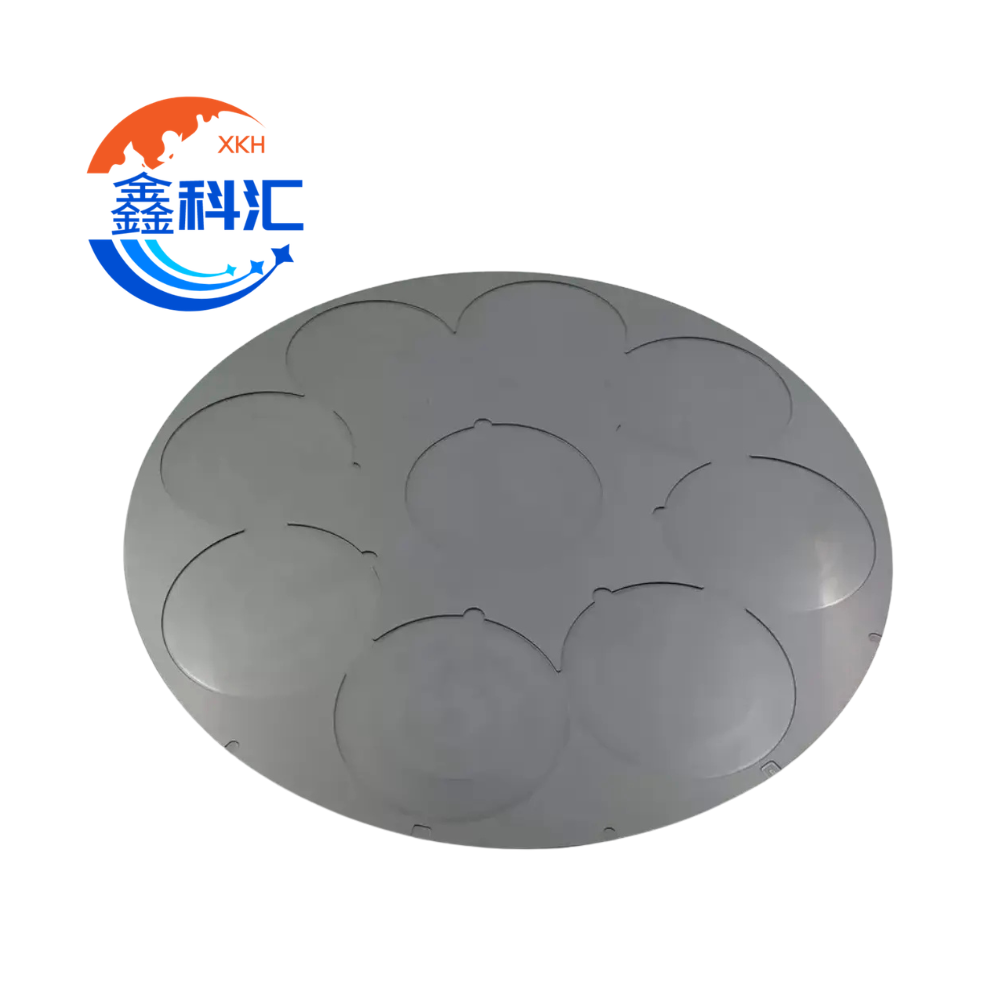
- Suportes de bolachas
- Dispositivos de alta temperatura
(2) Semicondutor SiC (material de bolacha)
Utilizado para:
- MOSFETs de potência
- Dispositivos de alta tensão
- Módulos de energia EV
Conceito principal: Otimização extrema do desempenho
O SiC foi concebido para:
condições térmicas, químicas e eléctricas extremas
Principais vantagens:
- Condutividade térmica extremamente elevada
- Expansão térmica muito baixa
- Excelente resistência à corrosão por plasma
- Estabilidade a altas temperaturas (>1000°C)
Limitação:
- Muito difícil e dispendioso de maquinar
- Sensível a defeitos durante a produção
3. Safira: Material ótico funcional de cristal único
A safira é fundamentalmente diferente da cerâmica e do SiC.
Ao contrário das cerâmicas policristalinas, a safira é uma cristal único de Al₂O₃.
Conceito central: Ordem estrutural + Função ótica
O seu valor não é apenas mecânico, mas também ótico:
- Elevada transparência (da gama do visível ao infravermelho)
- Dureza extremamente elevada (Mohs 9)
- Excelente resistência aos riscos
- Inércia química
Aplicações industriais:
- Janelas ópticas
- Sensores de infravermelhos
- Vidro de relógio
- Substratos para LEDs
- Capas de proteção
4. Tabela de comparação dos parâmetros-chave
| Imóveis | Cerâmica industrial (Al₂O₃ / ZrO₂ / Si₃N₄) | Carboneto de silício (SiC) | Safira (cristal único de Al₂O₃) |
|---|---|---|---|
| Estrutura do material | Policristalino | Poli / monocristalino | Cristal único |
| Densidade (g/cm³) | 3.2-6.0 | 3.1-3.2 | 3.98 |
| Dureza (Mohs) | 7-9 | 9-9.5 | 9 |
| Resistência à flexão (MPa) | 300-1200 | 300-600 (grau de engenheiro) | 400-700 |
| Condutividade térmica (W/m-K) | 20-30 (Al₂O₃), mais elevada para Si₃N₄ | 120-270 | 25-35 |
| Temperatura máxima de serviço (°C) | 1200-1600 | 1600-2000 | 1500-1900 |
| Expansão térmica (10-⁶/K) | 6-9 | 2.2-4.0 | 5.0-5.5 |
| Propriedades eléctricas | Isolador | Semicondutor / semi-isolador | Isolador |
| Transparência ótica | Não | Não | Excelente |
| Resistência à corrosão | Elevado | Muito elevado | Elevado |
| Maquinabilidade | Médio | Difícil | Muito difícil |
| Nível de custos | Baixo-Médio | Alta-Muito alta | Elevado |
5. Relação estrutural entre os três materiais
Em vez de concorrência, formam uma hierarquia funcional:
1. Cerâmica industrial → Camada de base de engenharia
- Concebido para poder ser fabricado
- Equilíbrio entre custos e desempenho
2. Carboneto de silício → Camada para ambientes extremos
- Extremos térmicos, químicos e eléctricos
- Aplicações de grau de semicondutor
3. Safira → Camada de cristal ótico
- Estabilidade monocristalina
- Transmissão ótica + dureza
6. Principais informações: Três filosofias diferentes de design de materiais
| Sistema de materiais | Filosofia da engenharia |
|---|---|
| Cerâmica industrial | Otimização com restrições |
| SiC | Desempenho em condições extremas |
| Safira | Pureza estrutural e funcionalidade ótica |
Isto explica o facto de raramente serem permutáveis em sistemas industriais reais.
7. Lógica de seleção prática (realidade industrial)
Em aplicações reais de engenharia:
Escolha a Cerâmica Industrial quando:
- São necessários componentes sensíveis aos custos
- É necessária resistência ao desgaste mecânico
- Estão envolvidas formas complexas
Escolha SiC quando:
- Existem ambientes de alta temperatura, corrosivos e de plasma
- Trata-se de equipamento de semicondutores
- A estabilidade térmica é fundamental
Escolha o Sapphire quando:
- É necessária transparência ótica
- É necessária resistência aos riscos + dureza
- Existem aplicações para janelas ou coberturas de proteção
8. Conclusão: Não é uma competição, mas uma divisão de papéis
A cerâmica industrial, o carboneto de silício e a safira não são substitutos.
Eles representam:
três ramos evolutivos da engenharia de materiais avançados
- Cerâmica → adaptabilidade à engenharia
- SiC → limite de desempenho extremo
- Safira → ordem ótica cristalina
Em conjunto, formam um ecossistema completo de materiais para as indústrias modernas de alta tecnologia.