Advanced semiconductor etching requires increasingly aggressive plasma environments.
Fluorine-containing gases are widely used to etch materials such as silicon oxide, silicon nitride and other semiconductor films.
The same plasma that removes material from the wafer also attacks the chamber.
This creates a major materials challenge.
Chamber-facing components must survive chemical attack and energetic ion bombardment without generating particles that can fall onto the wafer.
In 2026, yttrium oxyfluoride, or YOF, is receiving increasing attention as a plasma-resistant surface material.
Why Y₂O₃ Is Already Widely Used
Yttria, Y₂O₃, is widely used for plasma-resistant coatings because it forms relatively stable fluorinated surface products when exposed to fluorine-containing plasma.
Compared with many conventional oxide ceramics, it can provide:
- reduced chemical erosion;
- lower contamination;
- longer chamber-component life.
However, Y₂O₃ is not immune to plasma attack.
Repeated fluorination and ion bombardment can change surface roughness and release particles.
This is why researchers are looking at materials that already contain fluorine.
The Logic Behind YOF
YOF contains yttrium, oxygen and fluorine.
Because fluorine is already part of the material structure, the surface can be chemically closer to the fluorinated reaction layer that would otherwise develop gradually on Y₂O₃.
The goal is not simply lower mass loss.
For semiconductor manufacturing, the more important objectives may include:
- stable surface chemistry;
- low roughness change;
- reduced particle generation;
- reduced process drift.
A coating that erodes slowly but cracks and releases particles is still problematic.
New 2026 Research
A major October 2026 review of fluorine-plasma-resistant ceramic coatings concluded that pre-fluorinated materials such as YF₃ and YOF offer a favorable balance between chemical stability and surface integrity.
Importantly, the review emphasized that low corrosion rate alone does not guarantee low particle risk.
Another October 2026 study converted the surface of a Y₂O₃ coating toward YOF using YF₃-assisted heat treatment.
After exposure to CF₄/O₂/Ar plasma, the modified YOF surface showed a reported 23.8% lower surface-roughness change than the original Y₂O₃ coating.
These results explain why YOF is becoming an important coating-development direction.
YOF vs. Y₂O₃ vs. YF₃
There is no universal best material.
Y₂O₃
장점:
- mature coating route;
- established semiconductor use;
- good fluorine-plasma resistance.
제한 사항:
- initial surface fluorination;
- possible roughness evolution;
- particle generation after repeated exposure.
YF₃
장점:
- already fluorinated;
- good chemical stability in fluorine environments.
제한 사항:
- different mechanical and coating behavior;
- coating microstructure can influence durability.
YOF
Potential advantages:
- fluorinated chemistry;
- oxide-fluoride structural balance;
- good surface stability;
- potentially reduced process-conditioning change.
Actual performance depends strongly on plasma recipe and coating process.
Coating Microstructure Matters as Much as Chemistry
Two YOF coatings with the same nominal composition may perform differently.
Important variables include:
- porosity;
- coating thickness;
- grain structure;
- crack density;
- adhesion;
- surface roughness;
- deposition method.
Atmospheric plasma spray can create relatively thick coatings but may also create pores and splat boundaries.
PVD or other dense-film methods can create a different microstructure.
Therefore, material name alone does not define plasma lifetime.
Particle Control Is Becoming the Real Metric
At advanced semiconductor nodes, a microscopic particle can destroy a critical device feature.
For chamber ceramics, the key question is therefore shifting from:
How slowly does the ceramic corrode?
to:
How stable does the surface remain while it corrodes?
A coating may show a low average etch rate but still generate particles through:
- grain pullout;
- cracking;
- reaction-layer delamination;
- localized erosion.
Future chamber-material qualification is likely to evaluate both erosion rate and particle behavior.
Where YOF Could Be Used
Possible applications include:
- chamber liners;
- shields;
- plasma-facing rings;
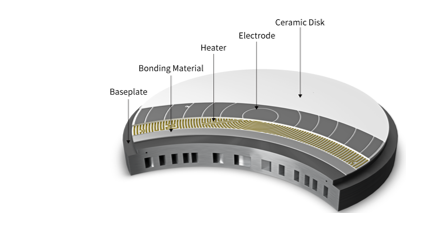
- electrode coatings;
- ceramic chamber walls;
- protective surfaces near the wafer.
The exact material should still be selected according to gas chemistry, RF bias, ion energy and contamination requirements.
Qualification Must Reproduce the Actual Plasma
A coating that performs well in one CF₄ test may behave differently in NF₃, CHF₃ or mixed plasma.
Useful qualification therefore needs to reproduce:
- gas chemistry;
- chamber pressure;
- source power;
- RF bias;
- component temperature;
- exposure time;
- cleaning cycle.
Side-by-side testing under the same chamber conditions provides much more useful information than comparing erosion values from unrelated publications.
Outlook
Y₂O₃ will remain an important semiconductor ceramic.
The emergence of YOF does not make yttria obsolete.
Instead, it reflects a broader industry trend:
plasma-resistant ceramics are evolving from simple bulk material selection toward engineered surface chemistry.
As etch processes become more aggressive, fluorinated ceramics and carefully controlled composite coatings are likely to become increasingly important.