In semiconductor manufacturing, wafer boats are used to hold and support wafers during high-temperature processes such as diffusion, oxidation, annealing and LPCVD. Although the structure of a wafer boat may look simple, the material choice is very important. Different materials can affect thermal stability, contamination control, mechanical strength, service life and overall process reliability.
Among the most commonly used wafer boat materials, silicon carbide, quartz and alumina ceramic are three important options. Each material has its own advantages and limitations. Choosing the right wafer boat material depends on the process temperature, wafer type, furnace environment, cleanliness requirements and cost considerations.
This article compares SiC, quartz and alumina wafer boats to help engineers and buyers better understand their differences.
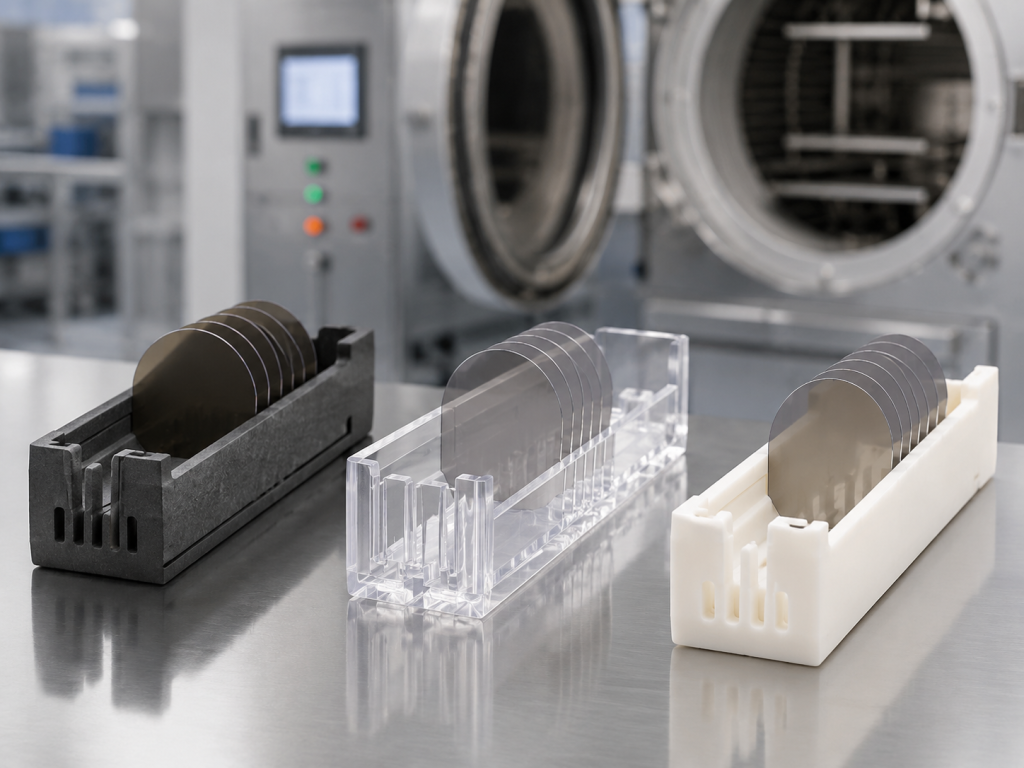
What Is a Semiconductor Wafer Boat?
A semiconductor wafer boat is a precision carrier designed to hold multiple wafers at fixed spacing inside a furnace tube or process chamber. It is widely used in thermal oxidation, diffusion, annealing, LPCVD and other semiconductor processes.
The wafer boat must keep wafers stable during loading, heating, processing and cooling. It also needs to withstand repeated thermal cycles, process gases and cleaning steps. For this reason, the material must be carefully selected.
A suitable wafer boat material should offer:
- Magas hőmérsékleti ellenállás
- Alacsony szennyeződési kockázat
- Jó méretstabilitás
- Strong mechanical support
- Kémiai ellenállás
- Alacsony részecskeképződés
- Hosszú élettartam
Silicon Carbide Wafer Boats
Silicon carbide, also known as SiC, is one of the most important materials for high-performance semiconductor wafer boats. It is especially suitable for demanding thermal processes where strength, stability and long service life are required.
Advantages of SiC Wafer Boats
SiC wafer boats offer excellent thermal stability and can be used in high-temperature furnace environments. Compared with quartz, SiC has higher mechanical strength and better resistance to thermal shock. This makes it suitable for repeated heating and cooling cycles.
Another important advantage of SiC is its strong resistance to deformation. During high-temperature processing, wafer boats must maintain accurate slot spacing and structural stability. SiC helps reduce the risk of bending, warping or mechanical failure.
SiC wafer boats also provide good chemical resistance in many semiconductor process environments. They are commonly used in oxidation, diffusion, annealing and advanced wafer processing applications.
Limitations of SiC Wafer Boats
SiC wafer boats usually cost more than quartz or alumina ceramic wafer boats. The machining process is also more difficult because SiC is a very hard material. For applications with lower temperature or less demanding requirements, SiC may not always be the most economical option.
However, for high-temperature, high-load or long-life applications, the longer service life of SiC can often justify the higher initial cost.
Typical Applications of SiC Wafer Boats
SiC wafer boats are commonly used in:
- High-temperature diffusion furnaces
- Oxidációs folyamatok
- Izzítási folyamatok
- LPCVD rendszerek
- SiC ostya feldolgozása
- Advanced semiconductor thermal equipment
- High-load wafer carrying systems
Quartz Wafer Boats
Quartz is another widely used material for semiconductor wafer boats. It has a long history in silicon wafer processing and is compatible with many traditional furnace systems.
Advantages of Quartz Wafer Boats
Quartz wafer boats are valued for their high purity and good chemical stability. In many silicon wafer processes, quartz is preferred because it introduces low contamination and performs well in clean thermal environments.
Quartz also has good thermal resistance and is widely used in oxidation, diffusion and other furnace processes. Because quartz components are common in semiconductor equipment, quartz wafer boats are often easier to match with existing quartz tubes, paddles and furnace systems.
Quartz wafer boats can be manufactured with precise slot structures and customized dimensions. They are suitable for many standard wafer sizes, including 2 inch, 4 inch, 6 inch and 8 inch wafers.
Limitations of Quartz Wafer Boats
The main limitation of quartz is brittleness. Quartz wafer boats are more fragile than SiC and alumina ceramic parts. They may crack or break under mechanical impact, heavy loading or rapid temperature changes.
Quartz may also have a shorter service life in harsh high-temperature environments. For repeated thermal cycling or heavy-duty semiconductor production, SiC may provide better durability.
Typical Applications of Quartz Wafer Boats
Quartz wafer boats are commonly used in:
- Silicon wafer oxidation
- Diffusion furnace processes
- Clean thermal processing
- Laboratory wafer processing
- Standard semiconductor furnace systems
- Processes requiring high material purity
Alumina Ceramic Wafer Boats
Alumina ceramic, also known as aluminum oxide or Al₂O₃ ceramic, is a widely used advanced ceramic material. It offers good hardness, electrical insulation, wear resistance and thermal stability.
Although alumina is not always the first choice for the most demanding semiconductor wafer boat applications, it can be suitable for specific wafer support components, custom fixtures and less aggressive furnace environments.
Advantages of Alumina Wafer Boats
Alumina ceramic wafer boats provide good mechanical strength and high hardness. They are more resistant to wear than quartz and can be used in applications where electrical insulation is important.
Alumina is also more cost-effective than SiC in many cases. For custom ceramic parts, laboratory fixtures or lower-temperature wafer handling applications, alumina can be an economical choice.
Another advantage is machining flexibility. Alumina ceramic can be processed into different shapes, including slotted carriers, support plates, ceramic rods and customized wafer holding fixtures.
Limitations of Alumina Wafer Boats
Compared with SiC, alumina has lower thermal shock resistance and may not perform as well in extremely harsh high-temperature semiconductor environments. It may also not match the ultra-high-purity requirements of some advanced wafer processes.
For critical front-end semiconductor processes, buyers should carefully confirm alumina purity, surface finish, particle control and chemical compatibility before use.
Typical Applications of Alumina Wafer Boats
Alumina ceramic wafer boats may be used in:
- Custom wafer holding fixtures
- Laboratory thermal processing
- Ceramic support components
- Electrical insulation structures
- Lower to medium temperature furnace applications
- Precision ceramic carriers for special equipment
SiC vs Quartz vs Alumina: Key Differences
The following comparison helps summarize the major differences between the three materials.
| Ingatlan | SiC Wafer hajó | Kvarc ostya hajó | Alumina Wafer Boat |
|---|---|---|---|
| Temperature resistance | Kiváló | Jó | Jó |
| Mechanikai szilárdság | Nagyon magas | Alsó | Magas |
| Hősokkállóság | Kiváló | Mérsékelt | Mérsékelt |
| Purity performance | Good to high | Nagyon magas | Depends on grade |
| Brittleness | Lower than quartz | Magas | Mérsékelt |
| Kopásállóság | Magas | Alsó | Magas |
| Kémiai ellenállás | Excellent in many processes | Jó | Jó |
| Költségek | Magasabb | Közepes | Lower to medium |
| Élettartam | Hosszú | Közepes | Közepes |
| Custom machining difficulty | Magas | Közepes | Közepes |
How to Choose the Right Wafer Boat Material
There is no single material that is best for every wafer boat application. The right choice depends on actual process conditions.
Choose SiC When High Strength and Long Service Life Are Required
SiC is recommended for demanding semiconductor furnace processes, especially when the wafer boat needs to withstand high temperature, repeated thermal cycling and heavy wafer loading.
It is suitable for applications where durability, dimensional stability and process reliability are more important than initial cost.
Choose Quartz When High Purity and Standard Furnace Compatibility Are Required
Quartz is suitable for many traditional silicon wafer processes. It is a good choice when high purity, clean furnace compatibility and established process history are important.
However, quartz should be handled carefully because it is fragile and may not be ideal for harsh mechanical or thermal shock conditions.
Choose Alumina When Insulation, Wear Resistance and Cost Control Are Important
Alumina ceramic may be a practical choice for customized wafer support parts, insulating carriers and non-critical furnace fixtures. It is also useful when cost control is important and the process environment is not too aggressive.
For high-end semiconductor processes, alumina grade and cleanliness should be carefully evaluated.
Important Specifications to Confirm Before Ordering
Before choosing a wafer boat material, engineers and buyers should confirm the following information:
- Wafer diameter and wafer thickness
- A helyek száma
- Slot pitch, slot width and slot depth
- Horizontal or vertical furnace use
- Maximum process temperature
- Process gas environment
- Required material purity
- Surface roughness requirement
- Dimensional tolerance
- Cleaning and packaging standard
- Várható élettartam
- Drawing or sample reference
A technical drawing is strongly recommended for custom wafer boats. If no drawing is available, buyers should provide the wafer size, furnace model, process temperature and application details.
Material Selection by Application
Different semiconductor processes may require different wafer boat materials.
For high-temperature oxidation and diffusion, SiC and quartz are commonly considered. SiC is preferred when strength and service life are critical, while quartz is preferred when high purity and traditional furnace compatibility are required.
For annealing and repeated thermal cycling, SiC can provide better stability and durability. For laboratory or customized wafer holding applications, alumina ceramic may be a cost-effective solution.
For advanced semiconductor equipment, material selection should consider not only temperature resistance, but also particle control, impurity level, surface finish and dimensional accuracy.
Következtetés
SiC, quartz and alumina are three important materials used for semiconductor wafer boats. Each material has different strengths.
SiC wafer boats offer excellent mechanical strength, thermal shock resistance and long service life, making them suitable for demanding high-temperature processes. Quartz wafer boats provide high purity and good compatibility with standard semiconductor furnace systems. Alumina ceramic wafer boats offer good insulation, wear resistance and cost advantages for selected applications.
For semiconductor manufacturers and equipment engineers, the best wafer boat material should be selected according to process temperature, cleanliness requirement, wafer size, equipment design and expected service life. A well-chosen wafer boat can improve process stability, reduce contamination risk and support reliable wafer production.