In advanced engineering industries such as semiconductors, precision machinery, and optical systems, průmyslová keramika, silicon carbide (SiC), and sapphire are often compared as competing materials.
However, this comparison is misleading if treated as a simple “which is better” question.
A more accurate understanding is:
These three materials represent three different material architectures, not just three performance levels.
- Industrial Ceramics → engineered polycrystalline systems
- Silicon Carbide → extreme-performance functional material
- Sapphire → single-crystal optical-grade material
They belong to different “material design philosophies,” not just different material families.
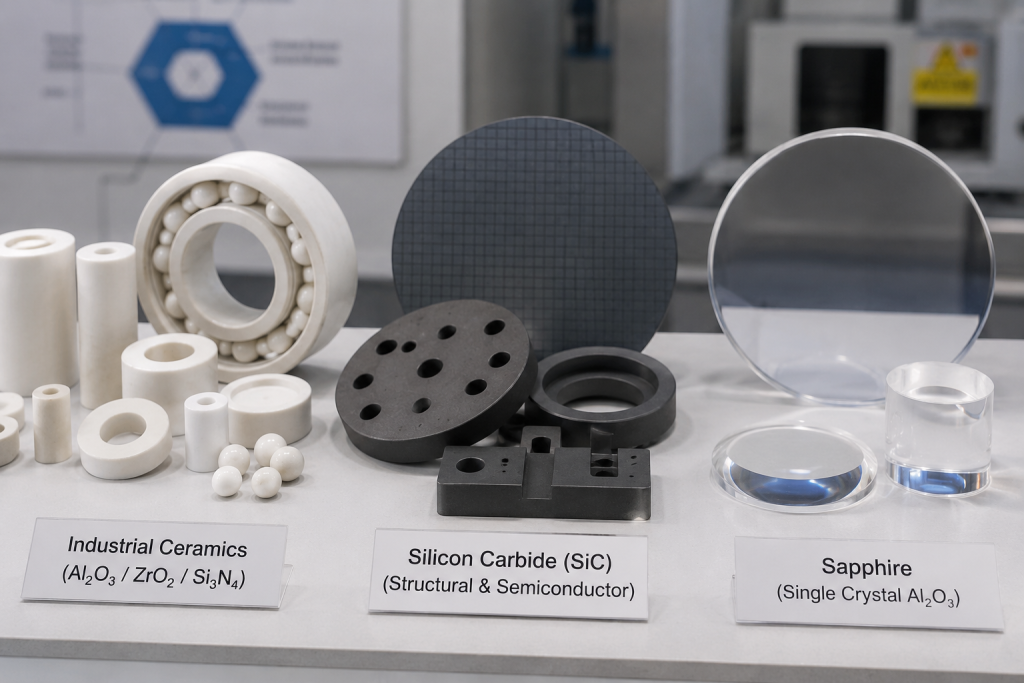
1. Industrial Ceramics: The Engineering Foundation Layer
Industrial ceramics refer to a broad class of polycrystalline materials, including:
- Keramický oxid hlinitý
- Zirkonová keramika
- Keramika z nitridu křemíku
- Reaction-sintered SiC ceramics
Core Concept: Designed Trade-Off Materials
Industrial ceramics are not defined by extreme performance, but by:
balanced engineering optimization between cost, machinability, and durability
Typical characteristics:
- High wear resistance
- Dobrá odolnost proti korozi
- Elektrická izolace
- Moderate to high mechanical strength
- Relatively cost-effective
Industrial role:
- Ložiska
- Mechanická těsnění
- Vodicí lišty
- Trysky
- Konstrukční prvky
2. Silicon Carbide (SiC): The Extreme Environment Material
Silicon Carbide exists at the boundary between ceramics and functional semiconductor materials.
It is unique because it serves two industries:
(1) Structural SiC (Engineering Components)
Používá se v:
- Semiconductor vacuum chucks
- Etching chamber parts
- Nosiče oplatek
- Vysokoteplotní upínací zařízení
(2) Semiconductor SiC (Wafer Material)
Používá se pro:
- Power MOSFETs
- High-voltage devices
- EV power modules
Core Concept: Extreme Performance Optimization
SiC is designed for:
thermal, chemical, and electrical extreme conditions
Hlavní výhody:
- Extrémně vysoká tepelná vodivost
- Velmi nízká tepelná roztažnost
- Outstanding plasma corrosion resistance
- High temperature stability (>1000°C)
Limitation:
- Very difficult and expensive to machine
- Sensitive to defects during production
3. Sapphire: Single-Crystal Functional Optical Material
Sapphire is fundamentally different from both ceramics and SiC.
Unlike polycrystalline ceramics, sapphire is a single crystal of Al₂O₃.
Core Concept: Structural Order + Optical Function
Its value is not only mechanical, but also optical:
- High transparency (visible to infrared range)
- Extremely high hardness (Mohs 9)
- Excellent scratch resistance
- Chemical inertness
Industrial applications:
- Optická okna
- Infrared sensors
- Watch glass
- LED substrates
- Protective covers
4. Key Parameter Comparison Table
| Majetek | Industrial Ceramics (Al₂O₃ / ZrO₂ / Si₃N₄) | Karbid křemíku (SiC) | Sapphire (Single Crystal Al₂O₃) |
|---|---|---|---|
| Material Structure | Polycrystalline | Poly / Single crystalline | Single crystal |
| Hustota (g/cm³) | 3.2–6.0 | 3.1–3.2 | 3.98 |
| Hardness (Mohs) | 7–9 | 9–9.5 | 9 |
| Pevnost v ohybu (MPa) | 300–1200 | 300–600 (engineering grade) | 400–700 |
| Tepelná vodivost (W/m-K) | 20–30 (Al₂O₃), higher for Si₃N₄ | 120–270 | 25–35 |
| Max Service Temperature (°C) | 1200–1600 | 1600–2000 | 1500–1900 |
| Thermal Expansion (10⁻⁶/K) | 6–9 | 2.2–4.0 | 5.0–5.5 |
| Elektrické vlastnosti | Insulator | Semiconductor / semi-insulator | Insulator |
| Optická průhlednost | Ne | Ne | Vynikající |
| Odolnost proti korozi | Vysoká | Velmi vysoká | Vysoká |
| Machinability | Střední | Difficult | Very difficult |
| Cost Level | Low–Medium | High–Very High | Vysoká |
5. Structural Relationship Between the Three Materials
Instead of competition, they form a functional hierarchy:
1. Industrial Ceramics → Engineering Base Layer
- Designed for manufacturability
- Vyváženost nákladů a výkonu
2. Silicon Carbide → Extreme Environment Layer
- Thermal + chemical + electrical extremes
- Semiconductor-grade applications
3. Sapphire → Optical Crystal Layer
- Single-crystal stability
- Optical transmission + hardness
6. Key Insight: Three Different Material Design Philosophies
| Material System | Engineering Philosophy |
|---|---|
| Industrial Ceramics | Optimization under constraints |
| SiC | Performance under extremes |
| Sapphire | Structural purity and optical functionality |
This explains why they are rarely interchangeable in real industrial systems.
7. Practical Selection Logic (Industrial Reality)
In real engineering applications:
Choose Industrial Ceramics when:
- Cost-sensitive components are needed
- Mechanical wear resistance is required
- Complex shapes are involved
Choose SiC when:
- High-temperature + corrosive + plasma environments exist
- Semiconductor equipment is involved
- Thermal stability is critical
Choose Sapphire when:
- Optical transparency is required
- Scratch resistance + hardness is needed
- Window or protective cover applications exist
8. Conclusion: Not a Competition, but a Division of Roles
Industrial ceramics, silicon carbide, and sapphire are not substitutes.
They represent:
three evolutionary branches of advanced materials engineering
- Ceramics → engineering adaptability
- SiC → extreme performance boundary
- Sapphire → crystalline optical order
Together, they form a complete material ecosystem for modern high-tech industries.