Semiconductor ceramics are a specialized class of electronic ceramic materials engineered to exhibit semiconductor behavior through controlled material modification. Unlike traditional conductive materials, their electrical properties are highly sensitive to external conditions such as temperature, light, electric fields, humidity, and surrounding gases. This unique responsiveness allows semiconductor ceramics to convert environmental changes into electrical signals, making them essential for a wide range of sensing and intelligent electronic applications.
Today, semiconductor ceramics play an important role in modern electronics, automation systems, environmental monitoring, household appliances, and emerging smart technologies.
What Are Semiconductor Ceramics?
Semiconductor ceramics are ceramic materials whose grains and grain boundaries have been modified to exhibit semiconductor characteristics. One defining feature is the formation of interface potential barriers within the material structure, resulting in distinctive electrical behaviors.
Unlike conventional semiconductors such as silicon, many ceramic materials originally behave as electrical insulators. Scientists discovered that certain metal oxide ceramics could develop semiconductor properties after undergoing specialized treatments.
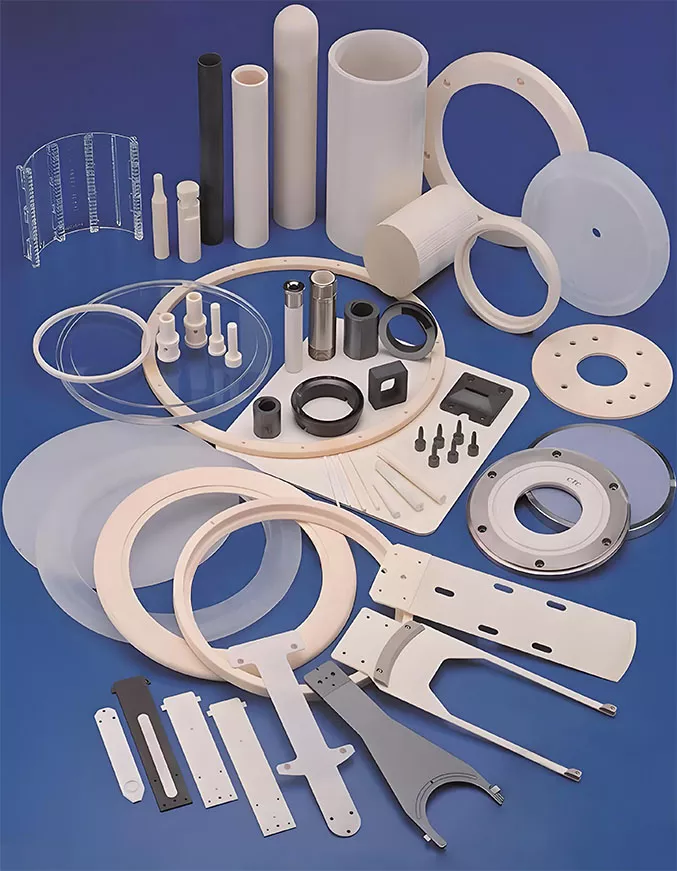
Materials such as:
- Barium titanate (BaTiO₃)
- Titanium dioxide (TiO₂)
- Zinc oxide (ZnO)
can become conductive after introducing trace amounts of specific additives.
Their electrical resistance falls between that of conductors and insulators, creating a class of materials known as semiconductor ceramics.
How Ceramics Become Semiconductive
Most semiconductor ceramics are based on oxide or complex oxide materials. To transform insulating ceramics into semiconductors, the internal crystal structure must be modified.
Two common approaches are widely used:
Reduction Treatment
Controlled reduction processes create oxygen vacancies and structural defects inside the ceramic crystal lattice. These defects generate free charge carriers and increase conductivity.
Doping Modification
Introducing small amounts of selected metal oxides alters the material’s electronic structure, producing charge imbalance and enabling semiconductor behavior.
Both methods create ionic vacancies and crystal defects that generate conductive electrons inside ceramic grains.
The resulting microstructure determines electrical performance and sensitivity characteristics.
Main Categories of Semiconductor Ceramics
Based on their response to environmental stimuli, semiconductor ceramics can generally be divided into several functional categories:
- Photosensitive ceramics
- Thermosensitive ceramics
- Varistor ceramics
- Humidity-sensitive ceramics
- Gas-sensitive ceramics
Each category serves different technological purposes.
Photosensitive Semiconductor Ceramics
Photosensitive ceramic materials can detect light energy across a broad wavelength range, from ultraviolet to infrared regions.
When exposed to light:
- Photons interact with the material
- Electrical conductivity changes
- The signal is converted into measurable electrical output
These materials are commonly used in photoresistors and optical sensors.
Applications include:
- Automatic lighting control
- Camera exposure systems
- Display brightness adjustment
- Smart home systems
- Remote sensing devices
An important application is solar energy conversion.
Photosensitive ceramic materials contribute to photovoltaic technologies capable of transforming solar radiation into electrical power, supporting renewable energy development and environmentally friendly power generation.
Thermosensitive Semiconductor Ceramics
Thermosensitive ceramics exhibit electrical resistance changes as temperature varies.
These materials form the basis of thermistors, which can generally be classified as:
- Positive Temperature Coefficient (PTC) thermistors
- Negative Temperature Coefficient (NTC) thermistors
- Critical Temperature Resistor (CTR) devices
Key advantages include:
- Wide temperature sensitivity range
- Excellent miniaturization capability
- High precision
- Good long-term stability
Some miniature thermistors can reach dimensions smaller than a fraction of a millimeter.
PTC Ceramic Applications
PTC thermistors increase resistance as temperature rises.
Common applications include:
- Overheating protection
- Constant-temperature heaters
- Temperature control systems
- Household heating devices
Because of their self-regulating characteristics, PTC ceramic heating technologies offer:
- rapid heating
- large heating areas
- improved safety
- flame-free operation
NTC Ceramic Applications
NTC thermistors behave oppositely: resistance decreases as temperature rises.
Applications include:
- air conditioning systems
- heating equipment
- digital thermometers
- battery temperature monitoring
- electronic medical devices
Modern ceramic temperature sensors can achieve fast response times and high measurement accuracy, allowing body temperature readings within seconds.
Varistor Ceramics for Circuit Protection
Varistor ceramics are semiconductor materials whose resistance changes dramatically with applied voltage.
Their electrical response is highly nonlinear.
Under normal operating conditions:
- resistance remains extremely high
- current flow is minimal
During sudden voltage spikes:
- resistance rapidly decreases
- excess current is diverted
- system voltage returns to normal
This behavior makes varistor ceramics essential protective components.
Typical applications include:
- surge protection devices
- transient voltage suppression
- lightning protection systems
- electronic circuit safety components
Certain ceramic compositions are particularly effective because of their excellent electrical characteristics and reliability.
Humidity-Sensitive Semiconductor Ceramics
Humidity-sensitive ceramic sensors detect changes in environmental moisture levels.
Their operation relies on:
- adsorption of water molecules
- changes in surface conductivity
- variations in electrical capacitance
Porous ceramic structures provide large surface areas and capillary channels that easily absorb moisture.
These sensors are widely used in:
- air conditioning systems
- environmental monitoring equipment
- smart appliances
- indoor climate control systems
Modern humidity-control technologies improve comfort while optimizing energy efficiency.
Gas-Sensitive Semiconductor Ceramics
Gas-sensitive ceramic sensors operate by selectively adsorbing target gases.
Gas interaction changes the material’s conductivity, allowing detection of:
- gas composition
- concentration levels
- environmental hazards
Applications include:
- alcohol detection devices
- air-quality monitoring systems
- industrial safety sensors
- smoke detectors
- fire alarm systems
Many fire detection systems integrate gas-sensitive and temperature-sensitive sensors for improved reliability and rapid response.
Future Outlook for Semiconductor Ceramics
Semiconductor ceramics represent a unique intersection between materials science and intelligent electronics.
As sensing technologies become increasingly integrated into everyday life, demand continues growing for materials that offer:
- higher sensitivity
- smaller dimensions
- lower power consumption
- greater reliability
- multifunctional integration
From smart homes and healthcare devices to industrial automation and environmental monitoring, semiconductor ceramics are becoming essential enabling materials for next-generation electronic systems.
Their ability to transform environmental information into electrical intelligence ensures they will remain a key area of research and technological development in the years ahead.